
When Federal Dollars Become an AI Lever
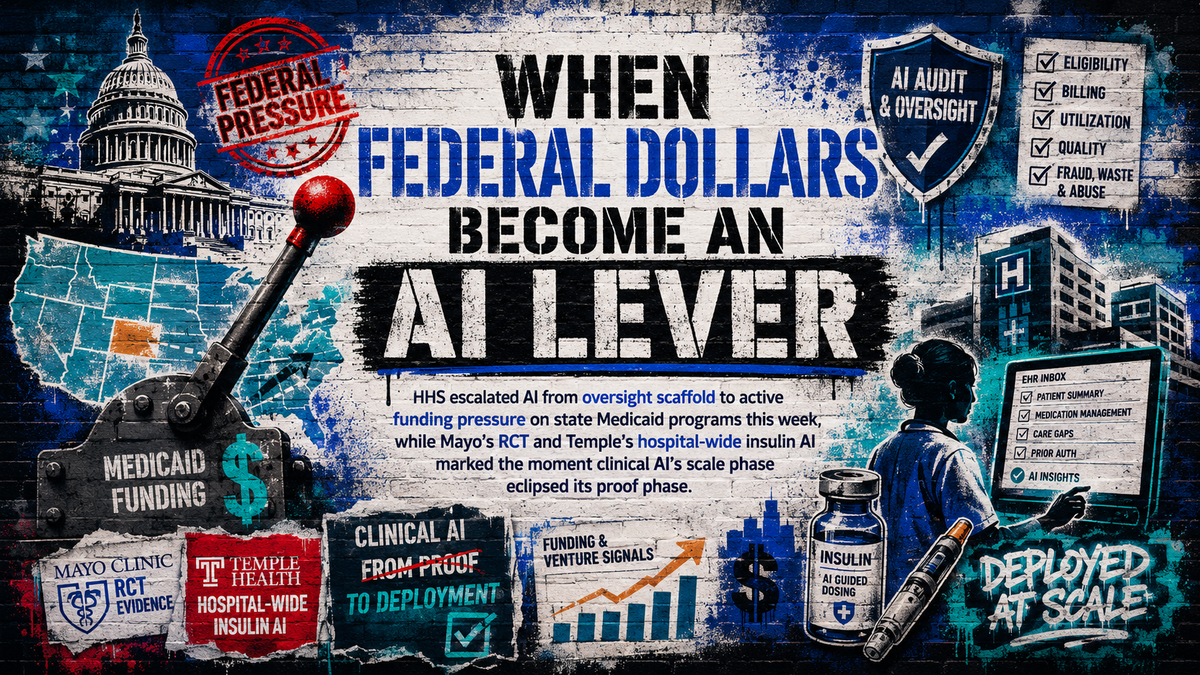
An AI-armed regulator is now auditing health systems that mostly do not have AI-armed defense. That is this week's strategic risk.
The federal direction has been telegraphed in this newsletter for weeks: HTI-1 rollback debate, AERO scoping, MACPAC pressure, FDA clearance escalation. This week the lever got pulled. HHS sent letters to all 50 governors telling them their Medicaid funding is now subject to AI-driven audit review with explicit withholding consequences. In the same five days, Mayo Clinic published a randomized trial of EHR-embedded clinical AI with hard readmission outcomes, Epic confirmed its inbox tools are live at 250 health systems with Stanford-measured time savings, and Temple completed its full hospital-wide insulin AI rollout with documented twofold hypoglycemia reduction.
The pre-2026 era of AI required vendors to prove their solutions worked. The era starting this week requires systems to prove they can survive an AI-armed regulator with their procurement, governance, and audit defensibility intact. AERO ties Medicaid dollars to algorithmic audit findings. OCR is restructuring around AI-HIPAA enforcement. MACPAC is pushing CMS the other direction on payer-side oversight. The audit defensibility playbook that worked last year is not the one that works now. In parallel, the clinical AI procurement bar moved from accuracy benchmarks to RCT-grade evidence with EHR-native integration. Health systems that have not commissioned an internal AI red-team review of their last five years of audit submissions, or refreshed their AI vendor evaluation criteria against the Mayo evidence standard, are operating against a 2024 posture in a 2026 enforcement environment. Initiatives that cannot survive the new floor are not strategic assets. They are exposure.
1. Signal Summary
- HHS turned AI into a state-funding pressure mechanism through the AERO initiative, sending letters to all 50 governors and tying audit findings directly to federal Medicaid dollars.
- Mayo Clinic's randomized trial of EHR-embedded AI drove a 44% increase in timely palliative referrals plus 25% and 28% reductions in 60- and 90-day readmissions. This is the cleanest clinical AI evidence package of the quarter.
- Temple completed system-wide rollout of predictive insulin AI with documented twofold reduction in hypoglycemia events. The deployable template for high-risk medication AI.
- Epic's generative AI inbox tools reached 250 health systems with Stanford documenting 22–24% reductions in physician inbox time. The EHR moat is now quantifiable.
- HHS restructured the Office for Civil Rights with explicit emphasis on AI-related HIPAA enforcement, layering a second federal pressure point alongside AERO.
- The federal foundation-model funding pattern sharpened with HHS awarding Ksana Health $17.9M for a multimodal behavioral model trained on wearable and EHR data across Providence, MedStar, and University of Washington.
2. Big Signal of the Week
HHS AI Medicaid Audits Create Direct Funding Risk for States
🔴 Major Signal | Score: 8.3 | View Article
Why It Matters The HTI-1 rollback debate, MACPAC's prior-auth recommendations, and CMS's WISeR pilot have all been covered in prior issues as discrete federal AI movements. AERO is different. It is the first federal AI deployment that ties a specific funding stream (Medicaid) to algorithmic enforcement at state level. Prior federal AI initiatives have been advisory, pilot-stage, or limited in scope. This one writes a check that does not get sent.
Key Details
- Organization: U.S. Department of Health and Human Services (AERO initiative)
- Mechanism: Generative AI analysis of five years of single-audit records across all 50 states
- Action taken: Letters to every governor warning that unresolved findings could trigger withheld federal funds
- Companion regulators: MACPAC pushing CMS the other direction on payer-side oversight; OCR restructure same week
- Watchdog response: Public Citizen has raised AI error-risk concerns
- Date: May 21, 2026
What This Signals Every Medicaid-heavy provider and state agency now has an AI-armed federal counterparty. Audit defensibility, historically a documentation discipline, becomes a model-aware discipline. The asymmetry of an AI-armed regulator against a non-AI-armed provider is no longer theoretical. It is the operating environment now.
My Read The scoping language in prior HHS announcements suggested AERO would be an analytical tool. The letters to all 50 governors moved it operationally from analysis to enforcement in a single news cycle. Federal AI policy is no longer a single coherent posture. HHS is loosening transparency obligations while simultaneously tightening enforcement leverage. Health systems still treating audit defensibility as a documentation discipline should commission an internal AI red-team review of the last five years of submissions before HHS does it for them. The first withheld-fund action will be the case study every Medicaid-heavy CFO references for the next 18 months. Get ahead of it now or be the case study.
Source: Modern Healthcare
3. Real World Deployments
Editor's note: This section is tighter than usual. We applied a strict filter this week: only deployments with documented achieved outcomes at the named operator. Several large rollouts were announced (MetroHealth Artisight 500 rooms, Apollo greenfield smart hospital, BMS Claude Enterprise to 30,000 staff) but lack achieved-outcome data at this stage. They appear elsewhere in the briefing where the framing fits.
Mayo Clinic Randomized Trial Validates EHR AI for Palliative Care
🔴 Real-World Deployment | Score: 8.2 | View Article
Why It Matters This is the cleanest clinical AI evidence package the field has produced in 2026. Randomized design, named flagship operator, EHR-native deployment, hard readmission metrics on a high-cost clinical pathway. Almost every clinical AI procurement conversation in 2025 was held with a weaker evidence base than this one.
Key Details
- Organizations: Mayo Clinic, Bayesian Health
- Use case: EHR-integrated tool flagging hospitalized patients for earlier palliative referral
- Achieved outcomes: 44% increase in timely palliative referrals; 25% reduction in 60-day readmissions; 28% reduction in 90-day readmissions
- Study design: Randomized clinical trial at Mayo Clinic
- Integration depth: Live EHR-embedded with continuous learning
- Date: May 19, 2026
What This Signals The procurement bar moved this week. RCT-grade evidence with embedded workflow integration is now the floor, not the ceiling. Operators should expect boards to ask why other vendors cannot match it, and they should expect vendors who cannot match it to compete on price or be displaced.
My Read Bayesian Health just set a competitive moat that the rest of the clinical AI field will spend the next 18 months trying to match. Watch two things. First, whether Bayesian can replicate these results in non-academic settings. Community hospital evidence will tell us whether this is generalizable or Mayo-specific. Second, whether competitors move toward RCT-grade publication strategies. The single-arm pilot study as procurement evidence is effectively closed. Boards asking "where is our Mayo-grade evidence" in Q3 will be answered better by leaders who started the portfolio re-evaluation this week.
Source: PR Newswire
Temple Deploys Predictive Insulin AI Hospital-Wide with Twofold Hypoglycemia Reduction
🔴 Real-World Deployment | Score: 7.8 | View Article
Why It Matters High-risk medication workflows now have a deployable AI template with the right human-in-the-loop design. Insulin dosing is one of the highest-liability inpatient workflows; a documented twofold drop in hypoglycemia events with clinician sign-off preserved is the deployment shape that survives internal scrutiny and external audit.
Key Details
- Organization: Temple University Hospital
- Tool: EndoTool Sub-Q (AI predictive insulin dosing)
- Achieved outcome: Twofold reduction in hypoglycemia events
- Deployment scope: Hospital-wide
- Timeline: 2022 pilot → 2025 full system rollout completed
- Governance: Clinicians retain final dose approval
- Adjacent operators using comparable tools: St. Luke's Health Network, Jefferson Health, Penn Medicine
What This Signals High-risk medication AI is no longer theoretical. The next workflow targets are visible: anticoagulation, sedation, vasoactive infusions. Pharmacy and quality leaders should be evaluating these categories now while procurement competition is moderate.
My Read The three-year pilot-to-scale arc is the realistic adoption curve for high-risk clinical AI, not the press-release version. Temple's deployment did not skip the work. It earned the scale decision through measured outcomes and preserved human oversight. The pharmacist-and-physician sign-off model is what makes this defensible to risk committees, and it is the design pattern operators should anchor on when evaluating adjacent medication-AI categories. Any health system running manual sliding-scale insulin protocols at scale now has a published peer benchmark on safety outcomes working against their quality metrics. The competitive pressure is upstream of the procurement conversation.
Source: The Philadelphia Inquirer
4. Market Signals
Epic Scales Generative AI Inbox Tools to 250 Health Systems
🔴 Market Signal | Score: 8.2 | View Article
Why It Matters Epic's HIMSS roadmap signaled the orchestration direction. This is the production proof at scale. With 250 systems live and a credible measured outcome at Stanford, Epic has converted early AI advantage into a deepening structural moat. Ambient documentation startups, copilot vendors, and clinical communication tools now compete inside Epic's gravitational field, not against it.
Key Details
- Vendor: Epic (with Microsoft Azure OpenAI)
- Scale: 250+ health systems live on generative AI inbox tools
- Named outcome operator: Stanford Health Care
- Achieved metric: 22–24% reduction in physician inbox time (per EHR activity logs)
- Cost model: Azure OpenAI consumption pricing pass-through
- Guardrails: Clinician sign-off preserved (no auto-send)
What This Signals Procurement teams now have a credible reference number for inbox-time benchmarking that ambient AI competitors must beat to justify their pricing. The "Epic vs. standalone ambient AI" conversation is no longer a vendor philosophy debate; it has hard data attached.
My Read The 22–24% number is the inflection. Stanford publishing measured outcomes from EHR activity logs (not vendor-reported usage stats) is the credibility move that resets the category. Best-of-breed ambient AI vendors must now demonstrate measurable improvement over Epic's native baseline, not just over the no-AI baseline. Cost discipline matters too. Azure consumption pricing at 250-system scale will produce its own market dynamic as systems start optimizing per-message economics. Watch whether Oracle Health, Meditech, athenahealth, or Veradigm attempt comparable scale claims. The laggard EHRs face an increasingly compressed catch-up window.
Source: TechSignal
Bristol Myers Squibb Deploys Claude Enterprise to 30,000 Staff
🔴 Market Signal | Score: 7.3 | View Article
Why It Matters First pharma-wide rollout of agentic AI at this scale. Anthropic's enterprise pharma footprint now competes meaningfully with OpenAI's flagship health-system footprint. The frontier-model competition in healthcare is becoming a two-vertical race.
Key Details
- Organizations: Bristol Myers Squibb, Anthropic
- Scale: 30,000 staff
- Scope: R&D and operations workflows
- Strategic context: Builds on Anthropic's prior pharma posture (Narasimhan board appointment, Coefficient Bio acquisition covered Issue 8)
- Outcome data: Not yet disclosed at this stage of rollout
What This Signals Cross-vertical AI strategy choices now have vendor consequences. Pharma operators evaluating frontier-model partners face a sharper differentiation choice between OpenAI (deeper provider footprint, broader public clinical references) and Anthropic (deeper pharma R&D footprint, governance investment).
My Read The headcount is the telegraph, not the proof. 30,000 deployed users is meaningfully different from a leadership pilot or a function-specific rollout; it implies workflow integration and change-management resourcing already underway. The outcome data will follow, and BMS will publish it when they have it. The strategic read for health system leaders is that pharma's AI infrastructure choices and provider AI infrastructure choices are diverging vendor by vendor. If your organization runs research operations or pharma-sponsored trials, the next round of partnership conversations will increasingly carry vendor-stack implications you did not have to navigate 18 months ago.
Source: BMS Investor Press Release
J&J Polyphonic Builds 100-OR Network in Abu Dhabi
🔴 Market Signal | Score: 7.6 | View Article (signup required)
Why It Matters First regulator-backed, multi-system, governed surgical video data network at meaningful scale. Whoever owns the training data owns the next generation of surgical AI. The competitive geography of surgical AI may be set abroad before it is set domestically.
Key Details
- Lead vendor: Johnson & Johnson (Polyphonic platform)
- Infrastructure partners: AWS, NVIDIA
- Regulator-sponsor: Abu Dhabi Department of Health
- Participating health systems: Cleveland Clinic Abu Dhabi, PureHealth, Mediclinic Group, NMC Healthcare
- Scale: Approximately 100 operating rooms
- Data scope: Surgical video, audio, and device telemetry with centralized analytics governance
What This Signals Regulators can accelerate structured OR data infrastructure when they choose to. Governments now have an active role as owners of surgical AI training datasets. U.S. health systems should expect to negotiate surgical data access on terms set by foreign markets that moved first.
My Read The Abu Dhabi deployment is doing two things American coverage has under-weighted. First, it inverts the usual U.S.-first deployment pattern for surgical AI. The training data infrastructure is being assembled in the UAE while U.S. systems debate governance frameworks. Second, the regulator-as-sponsor model is more interesting than the technology. When the Department of Health is the data custodian, the data-access and IP terms get set on government terms, not vendor terms. Pair this with the Aumet AI procurement traction across GCC markets (below in Funding) and the pattern is consistent: foreign markets are building healthcare AI infrastructure with less incumbent friction. U.S. surgical AI vendors should be modeling whether the next 24 months of clinical evidence comes from American or Middle Eastern deployments.
Source: Semafor
FDA Approves Expanded AI-Enabled Liquid Biopsy from Guardant Health
🔴 Market Signal | Score: 7.4 | View Article
Why It Matters Each clearance compresses the diagnostic-AI regulatory path for the next entrant. The Aidoc-style platform consolidation pattern documented in Issue 8 ($150M Series E, 31 FDA clearances) is replicating in the liquid-biopsy category.
Key Details
- Vendor: Guardant Health
- Regulatory milestone: FDA approval for expanded AI-enabled multiomic liquid biopsy
- Use case: Oncology testing with broader access to multiomic profiling
- Strategic context: Reinforces consolidation around platform-scale diagnostics vendors
What This Signals Diagnostic AI is consolidating into a small number of platform-scale incumbents. New entrants face increasingly long approval-to-commercialization runways. Standalone point solutions get acquired or absorbed.
My Read Procurement teams evaluating oncology diagnostics should anchor on clearance breadth and platform reference depth rather than feature-by-feature comparisons. The market-structure story is more important than this individual approval. Watch for the next pharma-diagnostic AI tie-up (e.g., Tempus-Quanterix from Issue 9, Roche-PathAI from Issue 9). The same pattern is replicating across modalities.
Source: Benzinga
SeeTreat Adaptive Radiotherapy FDA Cleared with Varian/Elekta Integration Paths
🔴 Market Signal | Score: 7.3 | View Article
Why It Matters Adaptive workflows are becoming a contested AI category in radiation oncology, and the major linear accelerator vendors will be forced to choose between deep integration with specialist vendors or competing internal builds. SeeTreat's FDA clearance positions it as the workflow-integration play in a category where incumbents still control the capital equipment.
Key Details
- Vendor: SeeTreat
- Regulatory milestone: FDA 510(k) clearance for ART1 adaptive radiotherapy software
- Integration partners: Varian, Elekta (workflow integration paths)
- Academic anchor: University of Virginia
What This Signals Radiation oncology AI is moving from algorithm to platform-integration play. Capital equipment relationships now carry AI integration risk; vendor lock-in extends beyond the linac into the dosimetry and adaptive layer.
My Read The Varian and Elekta integration framing is the strategic detail. Specialty AI vendors that can layer into incumbent capital equipment without requiring vendor displacement have a structurally easier procurement path than those that ask radiation oncology departments to replace working infrastructure. For department leadership, the question is whether your linac vendor's adaptive roadmap matches what specialist vendors are building, and whether your data architecture supports a multi-vendor adaptive stack if it does not.
Source: PR Newswire
5. Policy and Regulation
HHS OCR Restructure Signals Heightened HIPAA Enforcement on AI Data Uses
🔴 Policy / Regulation | Score: 7.2 | View Article
Why It Matters HHS restructured the Office for Civil Rights with explicit emphasis on AI-related HIPAA enforcement. This is the second federal pressure point assembled in the same week as AERO, compounding the state-AG and payer-audit pressure documented in Issue 10's "federal floor down, everything else up" framework.
Key Details
- Organization: U.S. Department of Health and Human Services (Office for Civil Rights)
- Action: Formal restructuring with stated AI-data-use enforcement focus
- Companion federal actions same week: AERO Medicaid audit initiative; ongoing HTI-1 transparency rulemaking
- Stakeholder context: State AG enforcement (Pennsylvania v. Character.AI, Issue 9) and payer audit programs continue layering
Executive Implication Privacy reviews of AI vendor contracts need to be re-opened. Vendor risk that was acceptable in 2024 may not survive 2026 enforcement posture. Procurement teams should add HIPAA-AI specific clauses to vendor due-diligence templates this quarter.
My Read The OCR restructure on its own would be a mid-tier regulatory signal. Landing in the same week as AERO makes it part of a coherent federal enforcement posture, even as transparency rulemaking moves the other direction. Health system general counsels should treat the OCR-and-AERO pair as the architecture HHS is assembling for AI-era compliance enforcement. Build vendor contracts and internal audit infrastructure against the higher floor, not the federal-rulemaking floor that may keep moving.
Source: HHS Press Release
6. Funding Signals
HHS Awards Ksana Health $17.9M for Multimodal Behavioral Foundation Model
🔴 Funding Signal | Score: 7.4 | View Article
Funding Context Federal contract to build a Large Health Behavior Model (LHBM) trained on smartphone, wearable, and EHR data, with Providence, MedStar Health, and University of Washington as participating health systems and research partners.
Why Capital Is Flowing Here Federal money is now actively seeding domain-specific foundation models inside operating health systems. This is a different posture from general-purpose LLMs adapted afterward, and a different posture from the "AI-Native Hospital" capital trajectory covered in Issue 7. This is foundation-model infrastructure paid for with federal dollars.
Key Details
- Awardee: Ksana Health
- Funder: U.S. Department of Health and Human Services
- Amount: $17.9 million
- Modality: Multimodal LHBM trained on continuous sensor data (sleep, mobility, language) linked to EHR cohorts
- Participating health systems: Providence Health & Services, MedStar Health
- Academic partner: University of Washington
- Scale: Proof-of-concept pilots scaling to tens of thousands of participants
What This Signals The federal foundation-model funding pattern is emerging. Watch for similar HHS or ARPA-H awards in cardiology, oncology, and primary care over the next 12 months. Health systems participating in the next federal foundation-model contracts will accumulate a participation premium that compounds across data, talent, and clinical references.
My Read The Anthropic-Gates Foundation announcement got more headlines this week. Ksana is the more important story. $200M from a foundation to a frontier AI lab is brand alignment; $17.9M from HHS to a domain-specific vendor with named operating health systems and a defined deliverable is infrastructure. The participation list (Providence, MedStar, UW) is the credentialing signal. Federal foundation-model funding now comes with named-system co-development as a default. Health system research operations leaders should be tracking which federal RFPs are seeding the next domain-specific models and positioning to be invited into the next cohort.
Source: Fierce Healthcare
Aumet Raises $12M Series A to Scale AI Procurement Across GCC Markets
🔴 Funding Signal | Score: 6.8 | View Article
Funding Context Series A for an AI-first procurement operating system connecting pharmacies, hospitals, and suppliers across GCC and emerging markets, with reported $1B GMV traction.
Why Capital Is Flowing Here Healthcare AI infrastructure money is finding non-U.S. markets where regulatory and incumbent friction is lower. Paired with the Abu Dhabi Polyphonic deployment above, the pattern is consistent: foreign markets are building first-mover AI infrastructure while U.S. systems negotiate compliance.
Key Details
- Company: Aumet
- Round: $12M Series A
- Lead investor: Emkan Capital (with Qatar Development Bank, SABAH VC, AAIC, Shorooq)
- Geographic focus: GCC and emerging markets
- Traction reported: ~$1B GMV across connected pharmacies, hospitals, suppliers
What This Signals GCC and emerging-market AI infrastructure plays deserve more attention than U.S. healthcare AI coverage typically gives them. The Aumet-and-Polyphonic pattern this week suggests the next 12–24 months of healthcare AI infrastructure precedents may be set outside U.S. borders.
My Read The $1B GMV figure deserves scrutiny (emerging-market GMV is not the same as U.S. health system supply spend), but the directional read is what matters. AI-native procurement infrastructure built in markets with less incumbent friction can later port back into U.S. systems with case-study credibility U.S.-only builds cannot match. Strategic acquirers and corp-dev teams in U.S. RCM and supply chain should be tracking emerging-market AI infrastructure as a future-acquisition pipeline.
Source: The AI Insider
7. Research Breakthroughs
Mayo Clinic RCT Establishes Peer-Reviewed Evidence Standard for EHR-Native Clinical AI
🔴 Research Breakthrough | Score: 8.2 | View Article
Why It Matters Cross-referenced from Real World Deployments above with a different framing: as the methodological reference standard the field has needed. Randomized design, named flagship operator, EHR-native deployment, hard outcomes, applied to a high-cost clinical pathway. This is the publication template every clinical AI vendor will be measured against for the rest of 2026.
Key Details
- Study design: Randomized clinical trial at Mayo Clinic
- Intervention: EHR-integrated AI for palliative care candidate identification
- Outcomes: 44% increase in timely palliative referrals; 25% reduction in 60-day readmissions; 28% reduction in 90-day readmissions
- Validation cohort: Single-site (Mayo); generalization studies pending
- Companion peer-reviewed clinical AI evidence cluster this quarter: Bayesian Health TREWS sepsis tool, Mass General lung cancer misdiagnosis study, Ada Health NEJM AI outcome study, Science physician-level reasoning paper
What This Signals The era of single-arm pilot studies as procurement evidence is closing. RCT-grade evidence with embedded workflow integration is the new procurement floor. Vendors without comparable evidence packages face a credibility deficit they did not have 30 days ago.
My Read Bayesian Health publishing this paper in the same calendar quarter as their FDA-cleared sepsis tool (TREWS) is not coincidence. It is a deliberate evidence-stacking strategy (clearance plus mortality endpoint plus RCT plus EHR-native integration) that competitors will need to match across multiple clinical domains, not just palliative care. Watch for similar publication cascades from Abridge, Suki, Microsoft Nuance, and other ambient AI category leaders within 12 months. Investors and strategic acquirers underwriting clinical AI valuations should anchor their evidence-standard expectations to Bayesian Health's publication cadence, not vendor accuracy benchmarks.
Source: Yahoo Finance
8. Trend to Watch
The fresh signal this week is the federal lever. HHS is using AI not for advisory oversight but for active funding pressure on state Medicaid programs. Prior issues have covered the regulatory scaffold (RAPID, AERO scoping, MACPAC recommendations, OpenEvidence's EU exit, HHS HTI-1 rollback). What changed this week is that the scaffold acquired an enforcement mechanism with an explicit dollar consequence tied to it.
The structural implication for health system leaders is that the federal compliance posture is no longer a single coherent direction. HHS is loosening transparency obligations (Covered in our Last Issue) while simultaneously tightening enforcement leverage (this week). MACPAC is pushing the payer side up while AERO is pushing the provider side down. The audit defensibility playbook that worked in 2024 (assume good faith, document carefully, respond to findings on the standard timeline) is not the audit defensibility playbook for 2026, when the regulator's first read of your audit submission is an AI inference, not a human reviewer.
The connected clinical signal is that the scale phase has eclipsed the proof phase. Mayo's RCT is now the procurement bar. Epic at 250 systems is the EHR-AI saturation point. Temple's hospital-wide insulin rollout is the high-risk medication template. J&J's 100-OR Polyphonic network is the surgical data infrastructure precedent. The operators who will look different in 2027 are not the ones still piloting. They are the ones operationalizing scale deployments against an audit posture that assumes AI on both sides of the table. Procurement is the cheap part. Audit defensibility and operating-model redesign are the parts with durable consequences.
9. Signal Scoreboard
RankHeadlineSignal ScoreCategoryWhy It Matters
- HHS AI Medicaid Audits Create Funding Risk | 8.3 | PolicyFederal AI gains an active money lever
- Epic AI Inbox Tools at 250 Health Systems | 8.2 | MarketEHR platform moat becomes measurable
- Mayo Clinic RCT for EHR-Native Palliative AI | 8.2 | DeploymentRCT-grade evidence resets procurement bar
- HHS AERO Five-Year Audit Review | 7.8 | PolicyAudit defensibility becomes AI-aware
- Temple Predictive Insulin AI Hospital-Wide | 7.8 | DeploymentHigh-risk medication AI template
- J&J Polyphonic 100-OR Abu Dhabi Network 7.6 | MarketSurgical data infrastructure built abroad
- Ksana $17.9M HHS Behavioral Foundation Model 7.4 | FundingFederal foundation-model funding pattern
- Guardant Health FDA Multiomic Approval | 7.4 | MarketDiagnostic AI consolidates around platforms
- BMS Deploys Claude Enterprise to 30,000 Staff | 7.3 | MarketAnthropic-vs-OpenAI vertical split deepens
- SeeTreat Adaptive Radiotherapy FDA Cleared | 7.3 | MarketRadiation oncology AI as integration play
10. Noise of the Week
Anthropic Partners with Gates Foundation Amid Reported $30B Investment
🟡 Funding Signal | Score: 4.8 | View Article
Why It Looks Important Big number ($200M committed by the Gates Foundation), marquee names (Anthropic, Gates Foundation), global health framing, and an obvious follow-on to Anthropic's expanding healthcare footprint (BMS Claude Enterprise, Coefficient Bio acquisition).
Key Details
- Funder: Gates Foundation
- Recipient: Anthropic
- Commitment: $200M
- Named operators: None
- Named deploying governments: None
- Measurable outcomes: None
- Workflow specificity: None
Why It Is Actually Noise Compare with the Ksana Health award above. Ksana: $17.9M, named participating health systems (Providence, MedStar, UW), defined deliverable, federal contract structure. Anthropic-Gates: $200M, no named operators, no named deploying governments, no described workflow. The announcement is brand alignment, not deployment. Until a specific government or health system reports a measurable intervention, this belongs in the future-state file, not the procurement file.
My Read Big-dollar foundation announcements pair poorly with procurement evidence. The signal-to-noise ratio for this kind of news is roughly inverse to the dollar figure. The bigger the commitment, the longer the runway between announcement and named-deployment proof. Watch for the first named government or named health system that reports a Gates-Anthropic intervention with measurable outcomes. That is when it becomes a market signal worth tracking.
Source: CNBC
Innovaccer Acquires CaduceusHealth to Make Revenue Cycle Autonomous
🟡 Funding Signal | Score: 4.5 | View Article
Why It Looks Important Healthcare AI M&A in a hot category (autonomous RCM) by a known platform vendor, the type of consolidation move that has produced real signals in prior issues (Roche/PathAI in Issue 9, Anthropic/Coefficient Bio in Issue 8).
Key Details
- Acquirer: Innovaccer
- Target: CaduceusHealth
- Reported deal value: ~$66M
- Stated rationale: Combine CaduceusHealth's RCM expertise with Innovaccer's AI-native platform; expand Flow suite into end-to-end ambulatory RCM
- Named customer outcomes: None disclosed
- Integration evidence: None disclosed
- Adjacent context: Reported Innovaccer layoffs alongside this acquisition
Why It Is Actually Noise The press release describes intent rather than installed base. Innovaccer's broader restructuring context, including reported layoffs alongside the acquisition, reads more as defensive consolidation than strategic expansion. Compare with the Adonis Series C from Issue 5 (named Mount Sinai customer, 270+ deployments), Aidoc's Series E from Issue 8 (31 FDA clearances, 60M annual cases), or even Anomaly Insights from Issue 10 (20+ named health system deployments).
My Read M&A press releases in already-consolidating categories should be evaluated against the acquirer's broader operational signals, not just the deal narrative. Operators evaluating RCM AI should wait for installed-base evidence and customer-published outcomes before treating this as a competitive shift. Until then, this is positioning theater.
Source: Healthcare IT News
Healthcare AI Signal · healthcaresignal.ai Week of May 18–24, 2026