
Trial by Evidence
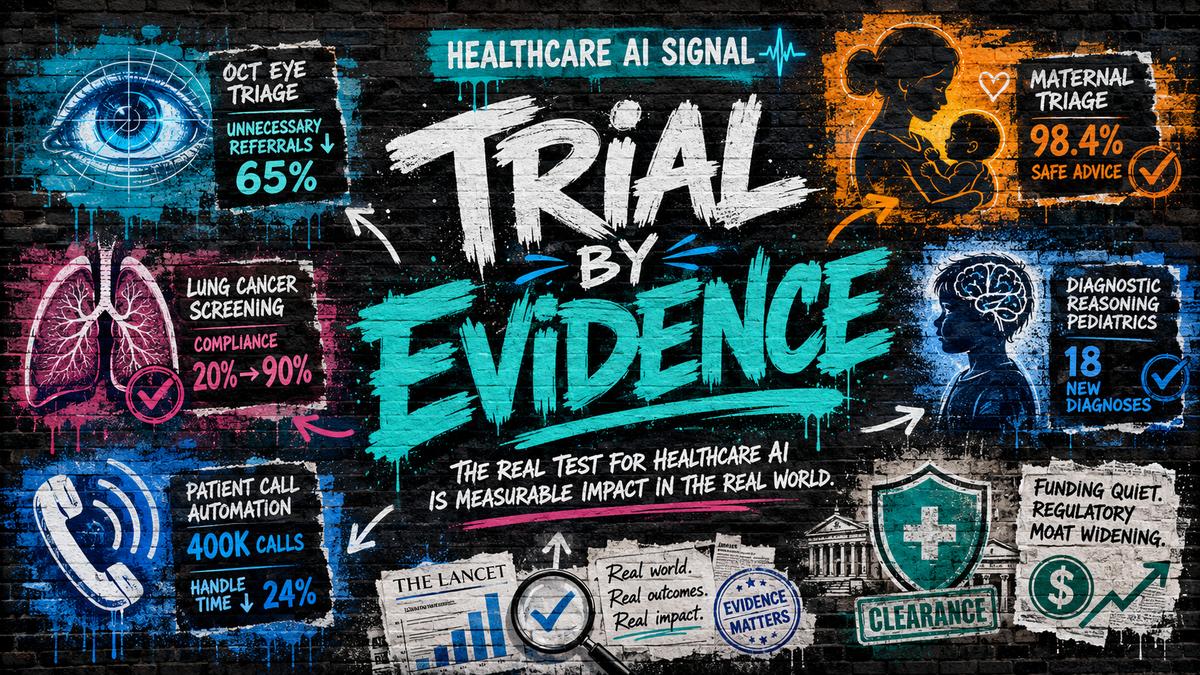
For three years, healthcare AI has been graded on a curve. A slick demo on a conference stage. A flattering pilot with a hand-picked denominator. A benchmark score on a dataset the model never has to face in a real clinic on a busy Tuesday. The pitch was always the same: imagine what this could do.
This week, the imagining stopped and the measuring started. The real test was never whether AI impresses in a ballroom, it is whether it moves the numbers that actually run a health system: fewer unnecessary referrals, more completed screenings, less time bleeding out of a call queue. Those answers landed this week, across screening, billing, and triage. And the most rigorous one did not come from a vendor deck. It came from a randomized trial, the same bar we set for drugs, and the AI cleared it.
1. Signal Summary
- A multicenter randomized trial showed AI optical coherence tomography triage cutting unnecessary diabetic macular edema referrals by roughly 65 percent while preserving safety, the cleanest measured utilization change of the week. Score: 7.8
- CommonSpirit lifted lung cancer screening compliance from about 20 percent to about 90 percent in pilot areas, with humans in the loop, and held it. Score: 7.4
- Cedar's Kora agent crossed nearly 400,000 patient calls across ten organizations in a full year, with a 24 percent reduction in live agent handle time. Score: 7.2
- A national maternal triage deployment in South Africa delivered safe advice in 98.4 percent of cases, raising the bar for what counts as adoption evidence. Score: 7.8
- A reasoning model produced 18 new diagnoses from 376 unsolved pediatric cases in a peer-reviewed NEJM AI study, a measured diagnostic yield rather than a benchmark. Score: 7.3
- Funding was quiet, with no megaround in the set. The capital signal is regulatory positioning in radiology, where incumbents are widening a clearance moat. Score: 7.3
2. Big Signal of the Week
Multicenter RCT Shows AI OCT Triage Safely Cuts Diabetic Macular Edema Referrals by 65 Percent
🔴 Major Signal | Score: 7.8 | View Article
Why It Matters This is the rarest kind of evidence in healthcare AI: a randomized trial that measures an operational outcome, not a diagnostic accuracy benchmark. Most AI studies tell you how often a model is right. This one tells you what happens to a clinic when you deploy it, roughly two thirds fewer needless specialist referrals, with no safety penalty. That is the utilization test, and the AI passed it under the most demanding study design available.
Key Details
- Study design: prospective validation followed by a multicenter randomized noninferiority trial (Hong Kong)
- Use case: AI optical coherence tomography triage for diabetic macular edema
- Result: unnecessary referrals fell from about 69 percent to about 24 percent, roughly a 65 percent relative reduction
- Safety: noninferiority preserved
- Parties: JAMA, Google Research
- Summarized by JAMA Network editors and podcast, June 18, 2026
What This Signals Specialist capacity is one of the hardest constraints in healthcare, and referral volume is the lever almost no one can move. A validated triage layer that safely removes a large share of unnecessary referrals is a capacity story dressed as an ophthalmology study. The same pattern, AI triaging who actually needs a specialist, applies across dermatology, cardiology, and any high-volume screening pathway with a referral bottleneck.
My Read: Healthcare AI has been graded on a generous curve for years, accuracy on a held-out dataset, a flattering pilot, a slick demo. A randomized noninferiority trial is the opposite of a generous curve. It is the evidentiary standard we apply to drugs, and applying it to a triage algorithm is exactly the maturity step this field needed. The 65 percent number is striking, but the design is the real signal. When AI triage starts clearing the RCT bar, the procurement conversation stops being about whether the model is impressive and starts being about why you have not deployed the capacity it frees. The systems still drowning in specialist backlogs now have a peer-reviewed answer they have to explain not using.
Source: JAMA / AMA Ed Hub (JN Learning)
3. Real World Deployments
Filtered to documented, achieved metrics only. Announcements without measured outcomes appear in Market Signals.
CommonSpirit Deploys AI for Cancer Screening and Incidental Findings With Humans in the Loop
🔴 Real-World Deployment | Score: 7.4 | View Article
Why It Matters A sustained compliance jump of this size is a durable workflow win, not a launch-week spike. CommonSpirit attacked a staffing and revenue gap that systems have chased for years, and the result held in real operations rather than in a demo.
Key Details
- Organization: CommonSpirit Health
- Use: automated screening outreach plus AI surfacing of incidental radiology findings
- Outcome: lung cancer screening compliance raised from about 20 percent to about 90 percent in pilot areas
- Oversight: explicit human-in-the-loop review
- Reported: Healthcare IT News, June 15, 2026
What This Signals Screening outreach and incidental-finding closure deserve their own AI program, with their own owner and a sustained-compliance metric, separate from documentation tooling. The measurable lever here is appropriate utilization going up where it should.
My Read: The number that matters is not the peak compliance figure, it is that it held. Most screening interventions spike during a campaign and decay afterward. A durable move from 20 to 90 percent means the workflow, not just the outreach, was redesigned. That is the hard part, and it is the part worth copying.
Source: Healthcare IT News
Cedar Marks One Year of Kora With Nearly 400,000 Patient Calls Handled
🔴 Real-World Deployment | Score: 7.2 | View Article
Why It Matters A full year of volume is itself the durability signal. An agentic billing workflow that holds across ten organizations and two major EHR environments has cleared the bar most agent pilots never reach, and it changed real staffing utilization in the contact center.
Key Details
- Vendor: Cedar (billing agent: Kora)
- Scope: nearly 400,000 patient calls across ten provider organizations
- Environments: Epic and Cerner
- Named organizations: Gastro Health, Hartford HealthCare, Keck Medicine of USC, ApolloMD
- Outcome: 24 percent reduction in live agent handle time (Gastro Health)
- Reported: PR Newswire, June 15, 2026
What This Signals Revenue cycle automation is a credible standalone category with emerging unit economics. For agentic tools, the questions to ask are cumulative volume over time and the staffing delta, not a flattering launch-quarter number.
My Read: The contact center is where most patients actually experience a health system, and it is chronically understaffed. A billing agent that absorbs a year of call volume is quietly doing capacity work that no one puts on a keynote slide. Watch Cedar push from billing toward the clinical edge next.
Source: PR Newswire / Cedar
4. Market Signals
Taiwan Hospitals Deploy NVIDIA Agentic AI and Robotics Across Clinical Workflows
🔴 Market Signal | Score: 7.3 | View Article
Why It Matters This is one of the clearest moves from narrow tools toward combined agentic and physical automation at multiple named hospitals, a preview of where the infrastructure and hardware stack is heading.
Key Details
- Parties: Foxconn, NVIDIA, Taichung Veterans General Hospital, Taipei Veterans General Hospital, Tungs' Taichung MetroHarbor Hospital
- Platform: Foxconn CoDoctor multi-agent orchestration
- Components: clinical AI agents (including ECG screening and colonoscopy support) plus the Nurabot logistics robot
- Initiative: Healthy Taiwan
- Status: no published workflow metrics yet
What This Signals The infrastructure thesis for agentic plus physical AI is forming, but the operational proof is not yet in. Treat this as a market signal rather than a proven deployment.
My Read: The combination of multi-agent orchestration and physical robots in named hospitals is the part to watch, because it tests whether agentic AI can move beyond the screen. Until nursing time saved or throughput data is published, this is a statement of direction, not a benchmark.
Source: Frontier Enterprise
Florence MCP Launch Gives Agentic AI Native Access to 65,000 Trial Sites
🟡 Market Signal | Score: 5.8 | View Article
Why It Matters Clinical trial operations are one of the least automated corners of healthcare, and exposing that infrastructure to agents is an early move toward agent-ready research workflows, a lane distinct from the documentation tools that dominate AI coverage.
Key Details
- Company: Florence Healthcare
- Launch: Model Context Protocol access, announced at DIA, June 17, 2026
- Scope: roughly 65,000 research sites and 30,000 protocols exposed through an agent-ready protocol
- Compatible agents: Claude and ChatGPT (Anthropic, OpenAI)
- Ecosystem references: IQVIA, Merck
- Status: early-stage, no outcomes published
What This Signals If sponsors and contract research organizations adopt agent-accessible trial infrastructure, the next proof point is measured cycle-time or enrollment gains. This is an ecosystem-positioning signal, not a results story.
My Read: Trial operations are slow, manual, and expensive, which makes them a natural target for agents. The interesting move here is structural: instead of selling another dashboard, Florence is making its data agent-addressable. Whether that translates into faster studies is the open question.
Source: Florence Healthcare
5. Policy and Regulation
Governance kept compounding this week, consistent with the arc we have tracked for several issues. We report it here but are not treating it as the week's headline.
FDA Draft Guidance Signals Lifecycle Oversight for Adaptive AI Medical Devices
🔴 Policy / Regulation | Score: 7.8 | View Article
Why It Matters Approval is becoming a lifecycle obligation rather than a one-time event. The draft guidance is built for software that changes after deployment, which is most clinically useful AI.
Key Details
- Agency: FDA
- Scope: draft guidance for AI-enabled medical devices
- Focus areas: model drift, bias, transparency, accountability, data poisoning
- Target: adaptive systems that change over time
- Status: draft, open for the standard process before final guidance
What This Signals Device teams need drift detection and documentation built in before final guidance lands. Continuous monitoring is becoming a design requirement, not a post-market afterthought.
My Read: The quiet implication is that the cost of bringing an adaptive model to market just went up, and that favors vendors who already built monitoring infrastructure. Health systems should require drift documentation from device vendors now rather than waiting for the rule to finalize.
Source: Health-ISAC
CMS Creates an Office of Health Technology and Products to Centralize AI Governance
🔴 Policy / Regulation | Score: 7.6 | View Article
Why It Matters The federal apparatus we have tracked through the spring is gaining permanent structure. A dedicated office means CMS-specific expectations on AI, interoperability, and product standards are coming.
Key Details
- Agency: CMS
- New office: Office of Health Technology and Products (OHTP)
- Subgroups: Product Development Group, Standards and Interoperability Group
- Mandate: enterprise leadership for digital products and CMS-wide AI strategy and implementation
- Reported: June 15, 2026, via Federal Register notice
What This Signals Prepare governance documentation against where this office is clearly heading. Engage early on interoperability and product standards, because reimbursement-adjacent requirements tend to follow structural moves like this.
My Read: Creating an office is the least glamorous and most durable kind of policy signal. Statements change with administrations. Org charts persist and accrete authority. This is the part of the governance build that will still matter in two years.
Source: Healthcare Innovation
6. Funding Signals
This was honestly a quiet funding week with no megaround in our analyzed announcements. The high-signal capital story is regulatory positioning, not a round.
FDA Data Shows Incumbents Consolidating Their Lead in Radiology AI Clearances
🔴 Funding Signal | Score: 7.3 | View Article
Why It Matters Clearance volume is no longer a back-office metric, it is a moat. In the largest AI device category, the established original equipment manufacturers are converting regulatory mastery into a structural advantage that pure-play vendors cannot easily match.
Key Details
- Data: FDA register of authorized AI-enabled devices through Q1 2026
- Total: 1,524 AI-enabled device authorizations
- Radiology share: about 76 percent of authorizations
- Leaders: GE HealthCare, Siemens Healthineers, Philips, with Canon, United Imaging, Aidoc, and DeepHealth also ranked
- Reported: The Imaging Wire, June 18, 2026
What This Signals Market access, not model quality alone, is becoming the gating factor. Expect consolidation, including acquisitions of clearance-rich smaller players into incumbent portfolios.
My Read: The radiology AI market is starting to resemble the imaging hardware market it grew out of, dominated by a handful of players who win on distribution and regulatory scale. For buyers, proven clearance volume lowers regulatory and continuity risk and deserves real weight in diligence.
Source: The Imaging Wire
Funding watch: This week's named raises were small NIH grants. The absence of a marquee round, against active infrastructure and platform moves, suggests value is migrating from financing events toward distribution and measured adoption.
7. Research Breakthroughs
Real-World Maternal Health Study Shows Safe AI Symptom Checker at National Scale
🔴 Research Breakthrough | Score: 7.8 | View Article
Why It Matters Prospective validation inside live public infrastructure, with real users at national scale, raises the adoption bar above benchmark accuracy. This is what proof looks like when it leaves the lab.
Key Details
- Platform: South Africa's government-led MomConnect
- System: a diagnostic decision support system integrated into the platform
- Result: safe advice in 98.4 percent of cases
- Secondary outcome: improved health-seeking behavior among pregnant women and mothers
- Setting: national, real-world deployment
What This Signals Treat prospective real-world safety data as a stronger procurement signal than benchmark performance when evaluating triage and symptom-checking tools.
My Read: A symptom checker that is safe 98.4 percent of the time in a controlled test is interesting. One that holds that safety across a national platform serving real patients is a different class of evidence. The integration into existing public infrastructure is the underrated part.
Source: Nature Health
NEJM AI Study Shows a Reasoning Model Delivering New Diagnoses in Unsolved Pediatric Cases
🔴 Research Breakthrough | Score: 7.3 | View Article
Why It Matters Concrete diagnostic yield on genuinely hard cases, peer-reviewed, moves reasoning models from benchmarks toward real clinical reasoning tasks.
Key Details
- Model: an OpenAI reasoning model
- Method: reanalysis of 376 previously unsolved cases
- Result: 18 new diagnoses
- Publication: NEJM AI, June 18, 2026
What This Signals Track reasoning model performance on unsolved cases as a potential augmentation layer for specialist and diagnostic teams, pending prospective validation.
My Read: Eighteen diagnoses out of 376 unsolved cases is not a headline number, it is a meaningful one. These are cases human teams could not crack. The competitive signal is which frontier labs convert benchmark performance into published clinical yield, because that is the new differentiation in the model market.
Source: OpenAI / NEJM AI
First Human Wireless BCI Implant Marks Early Clinical Entry for Neural Interfaces
🟡 Research Breakthrough | Score: 6.8 | View Article
Why It Matters Direct brain-AI interfaces are moving from lab prototypes into regulated human testing, expanding the frontier beyond software tools.
Key Details
- Device: Paradromics Connexus, a fully wireless implantable brain-computer interface
- Site: Michigan Medicine (University of Michigan Health)
- Study: Connect-One early feasibility study
- Goal: restore communication for patients with conditions such as motor neuron disease
- Status: first-in-human implant, no patient outcomes or long-term safety data yet
What This Signals Track BCI regulatory and reimbursement pathways as neural interfaces enter early clinical evaluation. This is a long-horizon signal, not a near-term procurement item.
My Read: This belongs on the radar precisely because it is early. The story today is the implant, not results. But the move from animal models and lab rigs to a first-in-human wireless device is the kind of threshold that looks small now and structural in retrospect.
Source: Michigan Medicine
8. Trend to Watch
The through-line this week is measured change in real utilization. The stories that scored highest were not the ones announcing a new capability, they were the ones reporting that a capability changed what actually happens: roughly 65 percent fewer unnecessary referrals in a randomized trial, screening compliance lifted and held, a year of call volume absorbed, a national symptom-checker proven safe in practice. That is a maturity marker. Early in a technology cycle the news is what a tool can do. Later, the news is what it measurably changes in a clinic, a referral queue, or a contact center.
The pattern to watch is whether the evidentiary bar set by the OCT trial spreads. A randomized noninferiority trial measuring an operational outcome is a high bar, and most vendors will resist it because their results live in benchmarks, not workflows. Expect sharper buyers to start asking for evidence of changed utilization, not changed accuracy, and expect the gap between the vendors who can produce it and those who cannot to widen. The next competitive line is not who has the best model, it is who can prove their tool moves a number a chief financial officer or a chief medical officer actually tracks.
9. Signal Scoreboard
- AI OCT triage RCT cuts DME referrals 65 percent | 7.8 | Research | RCT measures a real utilization change, not accuracy
- MomConnect maternal AI safety at national scale | 7.8 | Research | 98.4 percent safe advice with real users
- FDA draft guidance for adaptive AI devices | 7.8 | Policy | Lifecycle oversight for adaptive software
- CMS Office of Health Technology and Products| 7.6 | Policy | Federal structure continues to harden
- FDA review plus Joint Commission AI certification | 7.5 | Policy | Standardized governance criteria arrive
- CommonSpirit screening compliance 20 to 90 percent | 7.4 | Deployment | Durable compliance, not a launch spike
- FDA radiology clearance data, incumbents lead | 7.3 | FundingClearance scale as competitive asset
- NEJM reasoning model, pediatric rare disease | 7.3 | Research | 18 new diagnoses from 376 unsolved cases
- Taiwan, Foxconn, NVIDIA agentic and physical AI | 7.3 | Market | Infrastructure bet on agentic plus robotics
- Cedar Kora, 400,000 calls, 24 percent handle-time cut | 7.2 | DeploymentAgentic billing holds at a year of volume
10. Noise of the Week
Generative AI Firm Floats a Speculative Full-Body Ultrasonic Scanner
⚪ Noise | Score: 3.4 | View Article
Why It Matters On the surface it looks important: an image-generation company announcing a radiation-free full-body scanner generated heavy coverage and moved Butterfly Network's stock on a licensing mention.
Key Details
- Company: Midjourney (Midjourney Medical)
- Concept: a water-immersion "Ultrasonic CT" full-body scanner
- Market reaction: Butterfly Network shares moved on a licensing reference
- Evidence: no pilots, prototypes, or clinical data; no FDA diagnostic pathway; a spa-chain distribution idea
- Analysis flags significant acoustic and physical engineering obstacles
What This Signals This is a press cycle, not a deployment. The stock move is the tell: the market reacted to narrative, not measured use. An image-generation company with no medical device history is not a near-term clinical signal.
My Read: The cleanest contrast of the week is this announcement against the OCT trial. One gestures at a future scanner with no data. The other measured a real outcome under randomization. Spend your attention accordingly.
Source: Healthcare.Digital
The AI "Uber Moment" for Healthcare
⚪ Noise | Score: 3.8 | View Article
Why It Matters A major outlet framing AI as a physician-displacement inflection point reads as a landmark take and will circulate widely.
Key Details
- Outlet: The Atlantic
- Framing: AI as healthcare's "Uber moment," emphasizing physician displacement
- Technologies referenced: general tools from Microsoft, OpenAI, and Anthropic
- Evidence: no named health systems, no external validation, no measurable outcomes
What This Signals Sensational framing without named systems or validated outcomes is noise, however prominent the outlet. The hype language does the work the evidence does not.
My Read: The displacement frame is sticky and largely unearned. The week's actual evidence points the other way, toward AI changing specific utilization numbers under human oversight, not replacing clinicians wholesale. Treat this as narrative, not signal.
Source: The Atlantic