
The Stack Fills In
Week of June 28 - July 4
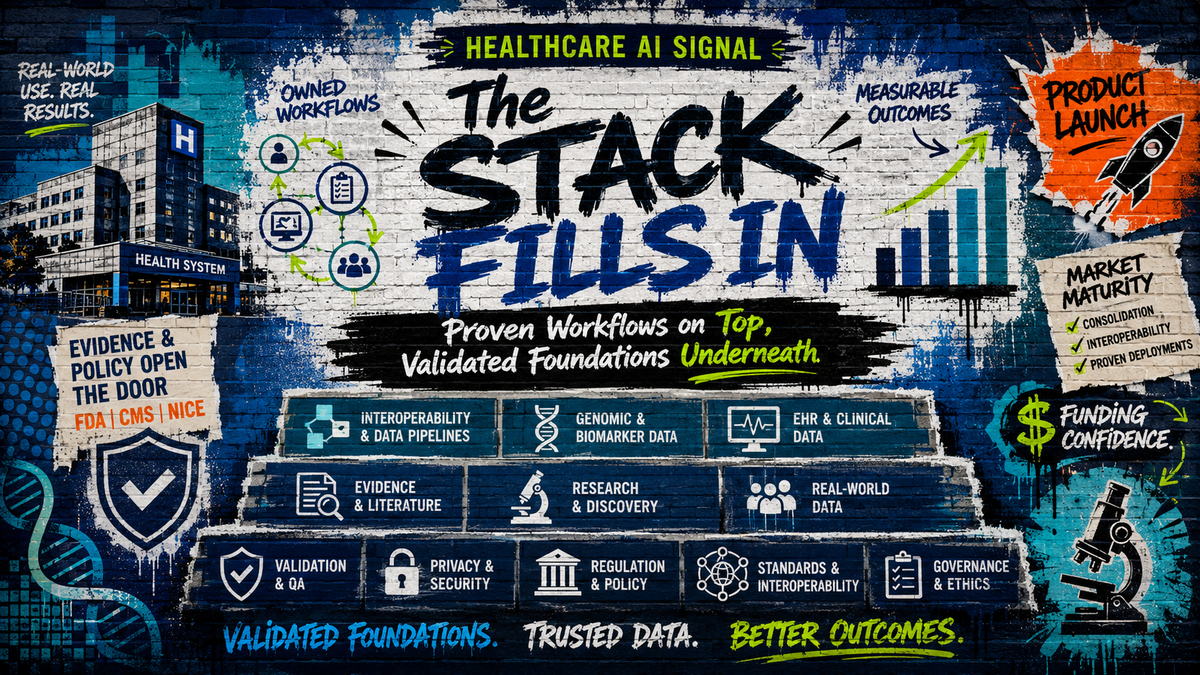
This was a consolidation week, and we held the line on evidence rather than filling space with announcements. What is left, read from the top of the stack down, tells one coherent story. At the top, the deployments that survived scrutiny share a trait: the health system owns the workflow and can show a result. In the middle, a fresh wave of cleared and validated tools is reaching the clinic on the strength of real testing. At the bottom, the foundation layer took a real step, with the largest integrated genomic-EHR resource in the world and a generalizable oncology model that beat 22 competing methods. And around all of it, capital and federal procurement are both reorganizing around the same demand this issue makes: prove it.
The Signal This Week
- Owned beats bought. The deployments that cleared this week share one trait: the health system owns the workflow and can show a number. Mercy (100,000 visits) and Nebraska Methodist (24-FTE equivalent) prove the capability rather than license it.
- The evidence bar did the editing. Two high-scoring deployments, a national ambient-scribe rollout and a national therapy contract, were held back for reporting adoption or intent rather than an achieved result.
- Validated tools are reaching the clinic. An FDA clearance for coronary plaque analysis and two large-scale validation studies (contactless sleep monitoring, robust keratitis diagnosis) show the pipeline from testing to bedside is moving.
- The advantage moved to the foundation layer. NIH's All of Us became the world's largest integrated genomic-EHR resource, and COMPASS showed a single validated model can predict immunotherapy response across 33 cancer types.
- Capital and procurement are demanding proof. TJM Labs raised and acquired its way to 450-plus pharmacies, and HHS moved to run head-to-head vendor pilots, both rewarding evidence over marketing.
- A consolidation week, named as one. Most of what moved rhymed with prior issues, so the honest signal is where genuinely new ground appeared: in owned deployments and validated foundations.
MOVEMENT I. Proven on Top: Owned Workflows With Real Numbers
The evidentiary bar this week did most of the editing. What is left is the set of deployments that name the system, run in production, and show an achieved result.
Mercy's CareNow Navigator: 100,000 Visits Booked, Product Ownership Is the Signal
🔴 Real-World Deployment | Score: 8.2 | View Article
Why It Matters Mercy embedded a patient-access automation inside MyMercy that triages low-risk requests, books appointments including virtual visits, and cleared a meaningful share of the clinician messaging backlog, booking nearly 100,000 visits in ten months. This is a different Mercy story than the revenue-lift coverage from April: the signal here is not the dollars, it is that Mercy ran this with product-management rigor and owns the capability end to end.
Key Details
- Organization: Mercy
- Tool: CareNow Navigator, embedded in the MyMercy patient portal
- Achieved outcome: Nearly 100,000 visits booked in ten months; reduced clinician messaging backlog
- Method: Product-development principles applied to AI ownership rather than model procurement
What This Signals The systems winning with AI treat it as a product capability they own and iterate, not a license they buy. Product management is the scarce internal skill, more decisive than model selection.
My Read Set this against the agentic patient-access funding wave that dominated last week, Assort at 120M and Trase at 107M, both selling access automation as a platform. Mercy is the buy-side answer to that sell-side story: a system that built the product muscle to own the workflow rather than rent it. That is the durable position, and it is repeatable across every workflow Mercy points it at next. The distinction from April matters. April was about revenue lift; this is about who controls the capability, which is the more strategic question as the access-automation category consolidates around well-funded vendors.
Source: Healthcare IT News
Nebraska Methodist CFO: RCM Automation Now Equals 24 Full-Time Employees
🟠 Real-World Deployment | Score: 7.3 | View Article
Why It Matters Nebraska Methodist's CFO detailed AI claim-status automation running since 2019 at a labor equivalent of roughly 24 FTEs, plus documentation-improvement AI to reduce denials, framing middle-cycle documentation as the highest-ROI area for revenue-cycle AI. Against a week of RCM funding noise, this is a named system with a seven-year operating track record and a hard number.
Key Details
- System: Nebraska Methodist
- Achieved outcome: Claim-status automation at roughly 24-FTE labor equivalent, running since 2019
- Focus: AI-assisted clinical documentation improvement to reduce denials
- Highest ROI: Middle-cycle documentation and coding
What This Signals Revenue-cycle AI is proven, quantified, CFO-endorsed infrastructure. The frontier has moved from "does it work" to "which workflow pays back fastest."
My Read The 2019 start date is what gives this weight. This is a seven-year track record, not a launch, and it lands a defensible figure: 24 FTEs. It also models the exact discipline the held stories lacked, an achieved, named number rather than a projection or a usage counter. The CFO's line about payers getting "innovative" at denials is the honest subtext of the whole RCM AI market: it is an arms race, and the systems automating their middle cycle stay ahead of it. Deprioritize front-end and generic tools against documentation and claim-status automation.
Source: RevCycleAI
MOVEMENT II. Reaching the Clinic: Cleared and Validated Tools
Between an owned workflow and a research paper sits the tool that has been tested hard enough to enter care. Three cleared this bar in one week, across different modalities.
How the Foundation Reaches the Clinic: FDA Clears Keya's DeepVessel Plaque
🟠 Regulation and Policy | Score: 7.6 | View Article
Why It Matters The FDA cleared Keya Medical's DeepVessel Plaque for quantitative coronary plaque analysis from CCTA imaging, delivering anatomical and functional read from a single scan, backed by a multicenter U.S. validation study. This is the third entry in the FDA-clears-specialist-cardiac-diagnostic arc we have tracked, after Cardiosense in May and Pathway Labs EchoNext last week. What is new is the modality: CCTA plaque quantification, not ECG.
Key Details
- Company: Keya Medical
- Clearance: FDA, DeepVessel Plaque for quantitative coronary plaque and stenosis analysis
- Capability: Anatomical and functional assessment from a single CCTA scan
- Evidence: Multicenter U.S. validation study
What This Signals Regulatory clearance continues to be the decisive gate for specialized cardiac AI, and the cleared tools are increasingly reaching clinicians through platform distribution rather than standalone sales.
My Read The single-scan, anatomical-plus-functional read is the operational hook. If one CCTA now yields what previously took additional testing, the workflow and reimbursement math changes, which drives adoption faster than accuracy alone. The open question is the same one we raised on EchoNext last week: clearance is the entry ticket, not the finish line, and the reimbursement gate has not closed. Evaluate cleared diagnostic AI by its distribution path, not the clearance alone.
Source: Cardiovascular Business
BCGNet: Contactless Under-Pillow Sleep and Apnea Monitoring, Validated at Scale
🟠 Research Breakthrough | Score: 7.3 | View Article
Why It Matters BCGNet is a two-stage transfer-learning model pre-trained on roughly 580,865 hours of polysomnography and fine-tuned on roughly 15,081 hours of ballistocardiography. Across multiple external cohorts it delivers strong four-class sleep staging, high correlation for apnea-hypopnea index estimation, and robust sleep-continuity metrics from a portable under-pillow contactless mat.
Key Details
- Pretraining: ~580,865 hours of polysomnography
- Fine-tuning: ~15,081 hours of ballistocardiography
- Capability: Four-class sleep staging and apnea-hypopnea index estimation
- Form factor: Under-pillow contactless monitoring mat
- Institutions: Five Seasons Medical, Massachusetts General Hospital
What This Signals Contactless sensing combined with large-scale transfer learning is progressing from proof-of-concept toward scalable population-level sleep and respiratory monitoring.
My Read The value is low-friction longitudinal monitoring: no wearable, no sleep-lab night, just a mat under the pillow. Sleep apnea is massively underdiagnosed precisely because the diagnostic pathway is high-friction, so a contactless screen that holds up across external cohorts is the kind of tool that could widen detection at population scale. The next proof is a named health-system deployment and integration into an existing sleep or cardiology workflow. Track it as a screening-access story, not a gadget.
Source: npj Digital Medicine (Nature)
AKDF-LQSI: Reliable Keratitis Diagnosis From Low-Quality Slit-Lamp Images
🟠 Research Breakthrough | Score: 7.1 | View Article
Why It Matters AKDF-LQSI combines improved-GAN image enhancement with lesion-aware classification to diagnose keratitis from low-quality slit-lamp images. Evaluated on a multicenter dataset of 10,498 images, it achieves an AUC above 0.949 and is aimed explicitly at reducing diagnostic disparities where imaging quality is limited.
Key Details
- Method: Improved GAN enhancement plus lesion-aware classification
- Dataset: Multicenter, 10,498 images
- Performance: AUC above 0.949
- Goal: Robustness to imperfect inputs and reduced diagnostic disparity
- Institutions: Xi'an University of Posts and Telecommunications, Wenzhou Medical University
What This Signals Diagnostic AI is advancing toward robustness against imperfect inputs, which expands its utility beyond high-resource imaging environments.
My Read Robustness to low-quality inputs is the unlock most diagnostic AI skips. Models trained and demoed on pristine images fail exactly where they are needed most, in rural and resource-limited settings without top-tier equipment. A framework that holds an AUC above 0.949 on deliberately poor images is doing equity work as an engineering property, not a mission statement. The next step is prospective integration into an actual ophthalmology workflow, but the design choice here is the one more diagnostic vendors should copy.
Source: npj Digital Medicine (Nature)
MOVEMENT III. Foundations Underneath: The Advantage the Model Layer Cannot Give You
When every serious player can rent a capable model, the edge moves to data assets and validated foundations. Two developments this week advanced that layer meaningfully, and public funding is now steering directly toward it.
NIH All of Us Becomes the Largest Integrated Genomic-EHR Resource in the World
🟠 Research Breakthrough | Score: 7.8 | View Article
Why It Matters NIH's All of Us data release now spans more than 747,000 participants, roughly 535,000 whole-genome sequences linked to nearly 482,000 electronic health records, plus proteomics and RNAseq subsets. It is one of the largest and most diverse integrated resources ever assembled for precision-medicine AI. (Companion NIH release also covered directly, Signal Score 7.6.)
Key Details
- Scale: 747,000-plus participants; 535,000-plus whole genomes linked to 482,000-plus EHRs
- Multi-omics: Initial proteomics and RNAseq subsets
- Diversity: Explicitly built for representation across underserved populations
What This Signals The foundation for precision-medicine AI is shifting toward large-scale public infrastructure. Model builders now benchmark against, and build on, a shared national asset.
My Read This briefing has argued for weeks that data access is becoming the competitive layer, most recently when TEFCA crossed a billion records. All of Us is the precision-medicine version of that shift, and it carries a twist worth naming: by partially democratizing the data, it moves the advantage up a level, from owning data to being fastest at turning it into validated, deployable models. That is the same ownership muscle Mercy shows on the deployment side. The cohort diversity is a competitive feature, not a compliance footnote, because models validated on representative data clear regulators and earn trust that narrow-cohort models cannot.
Source: Healthcare IT News
COMPASS: A Generalizable Foundation Model for Immunotherapy Response
🟠 Research Breakthrough | Score: 7.6 | View Article
Why It Matters The COMPASS concept-bottleneck foundation model, pretrained on 10,184 tumors across 33 cancer types, predicts immune-checkpoint-inhibitor response from bulk tumor transcriptomes. Across 16 clinical cohorts and 1,133 patients it outperformed 22 competing methods on average, generalized across cancers and therapies, and produced interpretable response maps. This is the freshest single story of the week, with no precedent in prior issues.
Key Details
- Pretraining: 10,184 tumors, 33 cancer types
- Evaluation: 16 cohorts, 1,133 patients, beat 22 methods on average
- Differentiator: Generalizes across cancers and therapies; interpretable response maps
- Institutions: Harvard Medical School, Massachusetts General Hospital
What This Signals Oncology AI is moving from narrow, task-specific predictors toward generalizable foundation models that could reset how biomarkers are discovered and how patients are stratified.
My Read The interpretability is what makes this more than a benchmark win. A model that produces inspectable response maps can survive tumor-board scrutiny and eventually a regulatory review; a black box cannot. Generalization across cancer types is the second unlock, because one validated foundation could replace a dozen bespoke single-indication tools. Stop assuming today's biomarkers are permanent. The next stratification standard may be a transcriptomic foundation model, and the systems tracking it now will not be caught flat-footed when the prospective trials read out.
Source: Nature Medicine
NIH PRIMED-AI Funds Data-to-Model Academic-Industry Partnerships
🟠 Funding Signal | Score: 7.2 | View Article
Why It Matters NIH's PRIMED-AI D2M-AIP notice funds academic-industry partnerships building image-centered multimodal AI decision-support tools, with explicit emphasis on validation, interoperability, data harmonization, and translation into deployable software as a medical device.
Key Details
- Program: NIH Common Fund PRIMED-AI, Data-to-Model Academic-Industrial Partnerships (UG3/UH3)
- Focus: Image-centered multimodal AI clinical decision support, built toward software as a medical device
- Emphasis: Validation, interoperability, data harmonization, clinical translation
What This Signals Public funding is steering multimodal AI toward validation and regulatory pathways rather than isolated benchmark performance. The money is following the deployable, not the impressive.
My Read This is the funding architecture that produces the next COMPASS. Following the Ksana behavioral-model award we covered in May, it confirms a pattern: federal money is underwriting the unglamorous middle of the pipeline, data harmonization and interoperability, which is exactly where most promising models die before reaching a clinic. Organizations aligning R&D to these requirements position for both grant capital and a cleaner regulatory path. Watch the first awardees.
Source: University of Georgia Research Insights (summary of NIH notice)
MOVEMENT IV. Around the Stack: Capital and Procurement Reward Proof
The money and the buyers moved the same direction this week, toward evidence. Both stories reinforce the discipline this issue is built on.
TJM Labs Raises $75M and Consolidates Pharmacy AI Across 450 Sites
🟠 Funding Signal | Score: 7.5 | View Article
Why It Matters TJM Labs closed a $75M Series B, is live in more than 450 pharmacies, and acquired two companies (EncoreRx, Pharmesol) in the same stroke, automating prescription intake, refills, and prior-authorization support. Capital, deployment footprint, and consolidation moved together, which is what a category leaving the pilot phase looks like.
Key Details
- Raise: $75M Series B, roughly $100M across rounds
- Footprint: 450-plus live pharmacies
- Consolidation: Acquired EncoreRx and Pharmesol
- Functions: Intake, data entry, refills, prior-auth support, patient communications
- Investors: Elephant, Arthur Ventures, Updata
What This Signals Pharmacy back-office AI has left the pilot phase. When a vendor raises and acquires simultaneously, it is buying market position, not runway. The production footprint is real; per-site performance outcomes are the next proof to demand.
My Read The acquisitions are the tell. A company still proving product-market fit raises to survive; a company acquiring competitors is consolidating a category it believes it has won. This fits the same pattern as last week's nine-figure agentic rounds: capital is concentrating on platforms that own a workflow. The prior-auth support function is the sleeper, because that is the highest-friction workflow in the pharmacy and where the margin lives. Hold the honest caveat too: 450 sites is deployment scale, not yet a published throughput or error-reduction number, and that number is what will separate TJM from the field.
Source: Dealroom.co
HHS Will Pit AI Vendors Against Each Other in Parallel Pilots
🟠 Regulation and Policy | Score: 7.4 | View Article
Why It Matters HHS issued a June 30 solicitation to run parallel AI pilots across multiple vendors, measuring consumption, governance, security, and workflow performance head to head before committing to an enterprise acquisition strategy. The federal government is replacing vendor marketing with structured comparative evidence.
Key Details
- Buyer: U.S. Department of Health and Human Services
- Date: June 30, 2026 solicitation
- Method: Parallel multi-vendor pilots, measured on consumption, governance, security, and performance
- Goal: Evidence-first enterprise AI acquisition strategy
What This Signals The largest healthcare buyer in the country is standardizing bake-offs. Vendors will need governance, security, and consumption reporting as first-class deliverables, and private health systems will import the same comparative rigor into their own contracts.
My Read This is procurement discipline as policy, and it will cascade. It also mirrors the exact stance this issue takes on its own stories: even the federal buyer now refuses to accept a marketing claim in place of head-to-head evidence. The vendors who benefit are the ones who can instrument their own governance and produce clean consumption and security data on request. The vendors who suffer are the ones whose value lives in the sales narrative. Build the reporting layer now; it is about to become a bid requirement everywhere.
Source: Washington Technology
Weekly Scoreboard: Top 10 by Signal Strength ( + 1 Bonus Article )
Ranked by Signal Score among stories cleared for publication.
- 8.2 · 🔴 Deployment · Mercy CareNow Navigator books ~100,000 visits via product-led access automation. · Healthcare IT News
- 7.8 · 🟠 Research · NIH All of Us hits 747,000 participants, the world's largest integrated genomic-EHR resource. · Healthcare IT News
- 7.6 · 🟠 Research · COMPASS foundation model predicts immunotherapy response across 33 cancer types. · Nature Medicine
- 7.6 · 🟠 Policy · FDA clears Keya Medical's DeepVessel Plaque for CCTA coronary analysis. · Cardiovascular Business
- 7.5 · 🟠 Funding · TJM Labs raises $75M, live in 450-plus pharmacies, acquires two competitors. · Dealroom.co
- 7.4 · 🟠 Policy · HHS to run parallel AI-vendor pilots for head-to-head operational evidence. · Washington Technology
- 7.3 · 🟠 Research · BCGNet delivers contactless under-pillow sleep and apnea monitoring from 600K hours of data. · npj Digital Medicine
- 7.3 · 🟠 Deployment · Nebraska Methodist quantifies RCM automation at ~24 FTEs after seven years live. · RevCycleAI
- 7.2 · 🟠 Funding · NIH PRIMED-AI funds validation-first data-to-model partnerships. · University of Georgia Research Insights
- 7.1 · 🟠 Research · AKDF-LQSI diagnoses keratitis from low-quality slit-lamp images at AUC above 0.949. · npj Digital Medicine
- 7.1 · 🟠 Policy · More states pass laws limiting AI in health-insurance determinations. · Sheppard Mullin
Noise of the Week
High-frequency announcements that scored below the signal floor.
- NVIDIA BioNeMo Agent Toolkit brought "accelerated AI" to life-science research with no named customers, pilots, or outcome data. Vendor announcement.
- Anthropic's Claude Science drew four separate write-ups this week, all covering the same beta workbench with early testers but no production deployments or measured outcomes. Interesting, not yet a signal.
- Anthropic will begin developing its own drugs with no named assets, timelines, or partners. Intent, not evidence.
- Sharecare taps AWS to power a health-navigation tool, with no launch date, named customers, or live workflow.
- One Brooklyn Health selects hellocare.ai for virtual care: a selection press release with no live deployment or measured outcome.