
The Scaffolding Goes Up
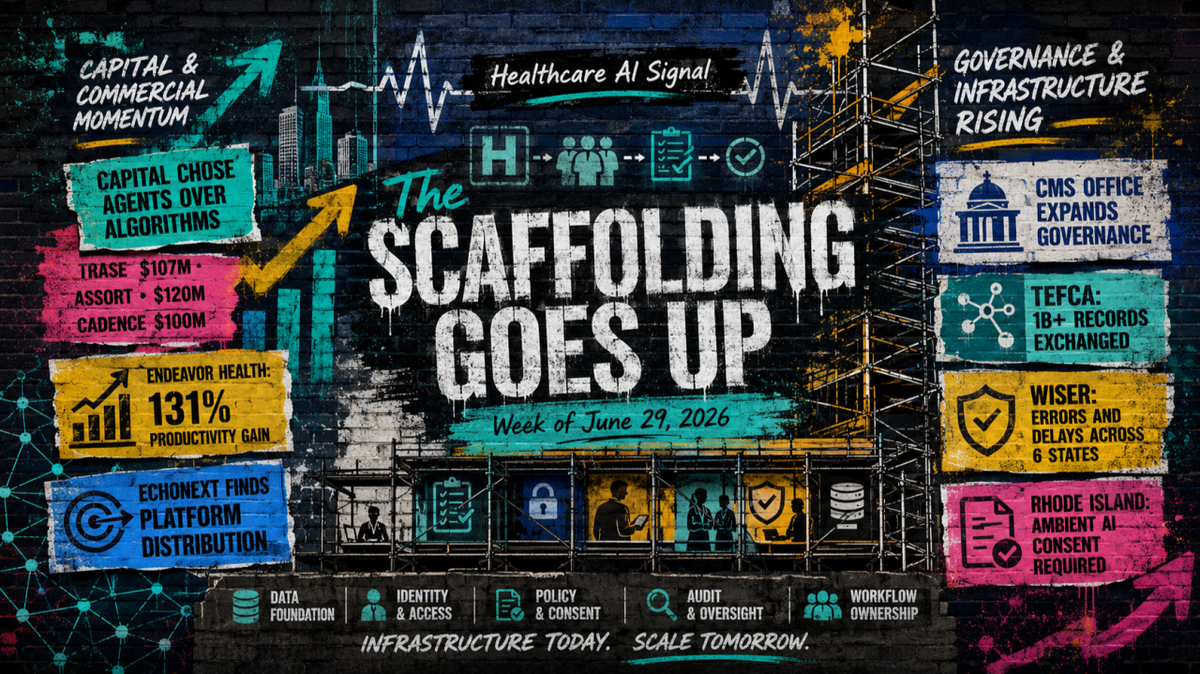
Week of June 21 to 27, 2026
This was a consolidation week, not a breakthrough one, and the absence of a blockbuster is itself the signal. Nothing in this weeks announcements cleared an 8.0, and the top tier capped at 7.8. What happened instead is more structural and arguably more important: the money and the rules moved in the same seven days, toward the same place.
Capital concentrated hard on agentic automation. Three nine-figure rounds landed at once, Trase at 107M, Assort at 120M, and Cadence at 100M, every dollar aimed at platforms that own a workflow rather than sell a feature. At the same time, the scaffolding went up underneath them. CMS stood up a permanent office to govern health technology and AI, TEFCA crossed a billion records exchanged, and Rhode Island wrote ambient AI consent into law.
The two movements are the story, and Medicare's own WISeR prior-authorization mess shows why they belong together: when the government ran AI ahead of its own governance, it produced errors and delays. The discipline that matters now is evidence. Only one deployment this week reported an achieved performance metric. Treat everything else as still in pilot, and read the rest of 2026 through one question: who governs, who funds, and who owns the workflow.
1. Signal Summary
- Capital chose agents over algorithms. Three large rounds landed in one week: Trase at 107M, Assort Health at 120M, and Cadence at 100M. The money is flowing to platforms that own administrative and chronic-care workflows, not to standalone decision support. This is the freshest signal of the week.
- Governed automation showed up on the floor, not just the org chart. Endeavor Health documented a 131% productivity gain on physician-governed refill automation, the one deployment this week with an achieved performance metric.
- The federal scaffolding added another box. CMS stood up a dedicated Office of Health Technology and Products, and ONC reported TEFCA has passed one billion records exchanged. Both are next chapters of an established governance and infrastructure arc.
- A cautionary deployment surfaced inside the government itself. Medicare's WISeR AI prior-authorization pilot is producing errors and delays across six states, the clearest live example of AI operationalized faster than it is governed.
- Diagnostic AI found a distribution channel. Pathway Labs' FDA-cleared EchoNext, trained on more than 700,000 ECG-to-echo pairs, will reach clinicians through OpenEvidence, signaling that clearance is now a ticket onto a platform rather than a finished product.
- State consent law arrived for ambient AI. Rhode Island now requires patient notification and opt-out when ambient AI is used in an appointment.
2. Big Signal of the Week
Endeavor Health Scales Physician-Governed AI Automation for Medication Refills
🔴 Real-World Deployment | Score: 7.8 | View Article
Why It Matters
This is the week's cleanest documented-metric deployment: a named system, a hard throughput number, and a governance model that explains why it stuck. We have spent recent issues tracking governance as it compounded at the federal level. This is governance doing operational work on the floor of a health system.
Key Details
- Organization: Endeavor Health
- System: JARVIS, AI automation for high-volume medication refills
- Outcome: 131% productivity improvement
- Governance: physician-led oversight, not an IT-only pilot
- Reported: Chief Healthcare Executive, June 24, 2026
What This Signals
Governed automation is moving from one-off pilots into repeatable back-office workflows where volume and process standardization create measurable leverage. The differentiator is who governs, not which vendor.
My Read: The number that matters is not 131 percent, it is the phrase physician-led. Most administrative AI dies in the gap between IT enthusiasm and clinician trust. Endeavor closed that gap by putting clinicians in the governance seat, and the throughput followed. This is the deployment version of the governance arc we have been tracking in policy for weeks, and it is the rare entry in this dataset that pairs a live workflow with an achieved performance number. Any system still running these as IT pilots is solving the wrong problem.
Source: Chief Healthcare Executive
3. Real World Deployments
Documented achieved metrics only. Usage volume, validation, and clearance milestones without an achieved performance outcome are held to Market Signals and Research.
Unfortunately only one deployment cleared the documented-outcome bar this week, and it is featured above as the Big Signal: Endeavor Health's JARVIS refill automation at a 131% productivity gain. Every other deployment in the dataset reported adoption volume, validation, or a fresh clearance rather than a measured performance gain, so they appear in Market Signals and Research below. In a week this thin on outcome data, the honest read is that most of the market is still pre-result.
4. Market Signals
Pathway Labs Launches FDA-Cleared EchoNext for Structural Heart Disease via OpenEvidence
🔴 Major Product Launch | Score: 7.6 | View Article
Why It Matters
A cleared diagnostic that removes a specialist bottleneck is consequential on its own. Pairing that clearance with a distribution channel is what makes this a market event: EchoNext does not have to win shelf space, it arrives inside a platform clinicians already use.
Key Details
- Company: Pathway Labs (product: EchoNext)
- Origin: trained at NewYork-Presbyterian and Columbia University
- Clearance: FDA-cleared to flag six structural heart conditions from a standard 12-lead ECG
- Training data: more than 700,000 ECG-echocardiogram pairs
- Evidence: published clinical validation plus a Nature Medicine case report
- Distribution: licensed into the OpenEvidence clinical decision-support channel
- Funding: 8.5M seed (AlleyCorp, Breyer Capital)
What This Signals
Validated diagnostic AI is becoming an embeddable layer inside an existing clinician platform rather than a standalone product. This continues the FDA-clears-specialist-replacing-diagnostic-AI arc we tracked in late May, with one new wrinkle: distribution now comes bundled with clearance.
My Read: Clearance used to be the finish line. Here it is the entry ticket, and the real move is the OpenEvidence channel. The reimbursement question we raised in late May has not closed, so the open issue is whether a cleared, well-distributed tool gets paid for in routine use. Evaluate diagnostic AI by its distribution path and platform dependencies now, not by the clearance alone.
Source: Boston Life Sciences Times (coverage of Pathway Labs / EchoNext)
UpDoc Debuts FDA-Cleared Agentic Clinical AI at Three Major Health Systems
🔴 Major Product Launch | Score: 7.2 | View Article
Why It Matters
An FDA-cleared platform that executes care tasks, rather than just drafting suggestions, is a step change in what regulators will authorize. The named-system roster signals this is past the demo stage, even if the outcome data is not in yet.
Key Details
- Company: UpDoc
- Clearance: FDA-cleared clinical AI platform, described as the first SaMD using patient-facing LLMs
- Capability: autonomous medication titration, lab orders, and EHR documentation within physician-approved parameters
- Named systems: Cleveland Clinic, Allegheny Health Network, UCSF Health
- Investors: Eli Lilly, Section 32, Polaris Partners, Pear VC, Cathay Innovation
- Use case: chronic disease management between visits
What This Signals
Healthcare AI is shifting from assistive tools toward autonomous workflow ownership in chronic disease and care coordination. The clearance-plus-flagship-logo combination is becoming the entry credential for the agentic category.
My Read: Read the cleared indications carefully, because the gap between marketing scope and predicate scope is where the next compliance fight lives. Named deployments are not the same as published outcomes. There are no performance metrics here yet, so this is positioning, not proof. The signal worth tracking is whether any of the three systems publishes safety or outcome data, which is the moment this moves from announcement to evidence.
Source: PR Newswire (UpDoc)
Hartford HealthCare Rolls Out EHR-Integrated Patient Chatbot Toward One Million Patients
🔴 Market Signal | Score: 7.4 | View Article
Why It Matters
Patient-facing AI with direct record access, scaling toward a million patients, is one of the more aggressive consumer-facing moves of the week. The guardrails are notable: prescribing is blocked by design.
Key Details
- Organization: Hartford HealthCare (built with K Health)
- Tool: PatientGPT, embedded in the patient portal
- Capability: interprets labs, flags medication interactions, summarizes conversations, helps schedule care
- Usage: 8,300 conversations across 6,000 patients in beta
- Rollout: planned expansion to more than 1 million patients
- Guardrail: blocked from prescribing or recommending treatments
What This Signals
Health systems are moving AI into direct patient-facing workflows rather than limiting it to clinician tools. The patient-engagement layer is becoming a live competitive battleground.
My Read: Hartford also surfaced last week as a named user of Cedar's Kora billing agent, so one system is now advancing on multiple AI fronts at once, which is itself a signal. The caution is the metric type. These are adoption figures, not outcomes. Until Hartford publishes a reduction in support volume or a gain in adherence, treat this as a scaled rollout to watch, not a proven result.
Source: The Hour (Hearst Connecticut Media)
5. Policy and Regulation
TEFCA Crosses One Billion Health Records Exchanged
🔴 Policy and Regulation | Score: 7.6 | View Article
Why It Matters
Data liquidity has been the quiet ceiling on scaled clinical AI. Crossing a billion records exchanged turns interoperability from policy aspiration into operational reality, and it does so at national scale.
Key Details
- Agency: ONC, within HHS
- Milestone: TEFCA has surpassed one billion health records exchanged
- Action: new oversight contracts and compliance reviews of Qualified Health Information Networks (QHINs)
- Relevance: structured, compliant data access for training and operating clinical AI
- Reported: HHS / ONC press release, June 26, 2026
What This Signals
Interoperability infrastructure is moving from aspiration to operational reality, lowering a key barrier to scaled AI and rewarding whoever integrates with TEFCA and QHIN pathways first.
My Read: The data layer is quietly becoming a competitive asset rather than just compliance plumbing. Map your AI data strategy to TEFCA and QHIN pathways now. The systems that wire into these rails early will hold an advantage that is hard to copy once data access becomes a procurement and, eventually, a payment condition.
Source: HHS (ONC) Press Release
CMS Creates a Dedicated AI Governance and Interoperability Office (OHTP)
🔴 Policy and Regulation | Score: 7.8 | View Article
Why It Matters
A standing office is a different thing than a guidance document. It creates a permanent home for AI governance inside the largest payer in the country, with the budget, staff, and continuity to shape procurement, certification, and eventually reimbursement.
Key Details
- Agency: Centers for Medicare and Medicaid Services (CMS)
- Action: established the Office of Health Technology and Products (OHTP)
- Mandate: technology modernization, interoperability, and AI implementation across CMS-managed programs
- Reach: Medicare, Medicaid, and CHIP
- Reported: Gardner Law, June 26, 2026
What This Signals
Healthcare AI governance is shifting from siloed, voluntary efforts toward coordinated federal standardization. The center of gravity for what counts as an acceptable AI deployment is moving toward CMS.
My Read: This is the next box on the federal governance org chart we covered two weeks ago, now drawn inside CMS itself. We treat it as a compounding arc, not a fresh headline, in keeping with the discipline of not letting governance carry the lead every week. The thing to watch is the moment OHTP links to audits, reimbursement, or certification. That is when governance stops being optional and starts being a line item.
Source: Gardner Law
Rhode Island Mandates Patient Notification and Opt-Out for Ambient AI Scribes
🔴 Policy and Regulation | Score: 7.2 | View Article
Why It Matters
This is enforceable state law, not voluntary guidance. It shifts ambient AI governance from vendor self-regulation toward mandated patient controls, and it creates concrete compliance work for any provider running scribes in the state.
Key Details
- Jurisdiction: Rhode Island General Assembly
- Law: requires providers to notify patients when ambient AI is used and to allow patients to opt out
- Timing: passed June 11, reported June 23, 2026
- Scope: part of a larger healthcare package that also addresses AI chatbot and mental health safety
What This Signals
State regulators are beginning to impose consent and transparency rules on ambient clinical AI, and the pattern is spreading state by state.
My Read: The compliance work here is small per deployment but expensive to retrofit. If you run ambient scribes, build the notification and opt-out workflow in now rather than after a similar bill passes in your state. Watch for copycat legislation and for the first compliance-cost data out of Rhode Island, which will tell every other provider what this actually costs.
Source: Healthcare IT News (HIMSS Media)
6. Funding Signals
Cadence Raises 100M Series C to Automate Chronic Care
🔴 Funding Signal | Score: 7.8 | View Article
Why It Matters
This is the cleanest market signal of the week. Capital is flowing to platforms that combine remote monitoring with supervised agents and own the chronic-care workflow under value-based economics. The named-system list is the diligence.
Key Details
- Company: Cadence (AI-powered chronic care platform)
- Round: 100M Series C, led by Spark Capital, with Thrive Capital, General Catalyst, Coatue, and B Capital
- Scale: more than 100,000 active patients
- Named systems: Corewell, Memorial Hermann, Duke, Providence, Yale New Haven, Hackensack Meridian, Lifepoint, Community Health Systems, Hartford HealthCare, Rush
- Capability: connected-home monitoring with real-time AI medication titration for heart failure, hypertension, and diabetes
- Evidence: published peer-reviewed outcomes
What This Signals
AI is moving from pilots into repeatable operational platforms for high-volume chronic disease management, funded against value-based economics rather than feature lists.
My Read: Three nine-figure rounds in one week is not three separate stories, it is one story about where the smart money believes the defensible position is. It is not the model, it is the workflow and the contract. Cadence raised on a roster of health-system logos and peer-reviewed outcomes, which is exactly the moat that point-solution vendors cannot cross. The market just told you what it will pay for.
Source: MedCity News
Trase Lands 107M to Scale AI Agents for High-Stakes Workflows
🔴 Funding Signal | Score: 7.2 | View Article
Why It Matters
A seed round this large is a statement of conviction. It signals concentrated investor belief that agent platforms can own high-volume administrative work that legacy automation never handled well.
Key Details
- Company: Trase
- Round: 107M seed, unusually large for the stage
- Product: Trase Origin, an agentic AI operating system
- Scope: patient access, clinical research, and revenue cycle
What This Signals
Healthcare AI capital is prioritizing operational agent layers over clinical decision support, indicating buyer demand for workflow ownership in back-office functions.
My Read: Operators should treat agentic scheduling and coordination tools as credible near-term alternatives to legacy RPA or manual processes, not as future technology. The proof point still missing is live multi-site deployment with quantified reductions in administrative cycle time or cost. A 107M seed buys the runway to produce that evidence, and the companies that publish it first will define the category.
Source: MobiHealthNews
Assort Health Raises 120M Series C for Patient-Journey AI Agents
🔴 Funding Signal | Score: 7.2 | View Article
Why It Matters
This round comes attached to real traction, not just a vision. The interaction volume and EHR integrations suggest a category is forming around agentic automation of administrative labor.
Key Details
- Company: Assort Health
- Round: 120M Series C, led by Menlo Ventures, with Lightspeed, Felicis, First Round, and others
- Traction: 190 million interactions cited
- Integrations: Epic and Athena
- Capability: scheduling, intake, referrals, document processing, medication refills, and eligibility
- Named customers: John Muir Health, MDCS Dermatology
What This Signals
Healthcare AI is moving from pilots to scaled agent deployment for back-office and patient-facing administrative labor, with a few well-capitalized players consolidating the patient-access workflow.
My Read: If you are still automating scheduling, intake, and referrals piecemeal, the category is forming without you. The diligence question for buyers is repeatability: does the efficiency gain hold beyond the initial EHR integrations, and is there a quantified labor delta. The interaction count is impressive, but the number that closes deals is hours or dollars saved per site.
Source: PR Newswire (Assort Health)
7. Research Breakthroughs
Clinical Trial Evidence: ECG AI Detects Cardiac Damage Clinicians Miss
🔴 Research Breakthrough | Score: 7.2 | View Article
Why It Matters
Diagnostic AI is graduating from accuracy benchmarks to prospective clinical evidence. A trial showing AI catching severe heart damage that clinicians miss is the kind of result that moves trust and adoption.
Key Details
- Source: The New York Times, June 22, 2026
- Finding: a clinical trial using an AI program found evidence of possible severe heart damage on ECGs that clinicians missed
- Access: one program is to be made widely available to doctors for free
- Domain: cardiac diagnostics on standard ECGs
What This Signals
Healthcare AI validation is advancing from benchmark performance toward prospective clinical evidence that could influence diagnostic trust and referral patterns.
My Read: Free distribution changes the adoption math entirely. A tool that is both validated and free of friction spreads on a different curve than one gated behind procurement. Track which ECG AI tools earn external clinical validation and low-friction access, and stop treating every diagnostic AI claim as equal. The follow-on question is whether free reach translates into measured changes in outcomes or referrals.
Source: The New York Times
Cedars-Sinai Validates Inpatient Hypoglycemia Prediction Across Three Hospitals
🔴 Research Breakthrough | Score: 7.4 | View Article
Why It Matters
Inpatient hypoglycemia is a high-stakes, preventable safety event. A model that predicts it a full day ahead, validated prospectively across multiple hospitals, is meaningful translational progress.
Key Details
- Organization: Cedars-Sinai, published in npj Digital Medicine
- Model: an LSTM deep-learning model analyzing medications, labs, meals, and EHR data in four-hour windows
- Capability: predicts inpatient hypoglycemia up to 24 hours ahead
- Data: more than 143,000 admissions across three hospitals, prospectively tested
- Status: validation, not yet a live deployment outcome
What This Signals
Predictive AI for operational safety is moving from retrospective benchmarks to prospective, multicenter validation, tightening the link between model performance and expected clinical adoption.
My Read: This is validation, not an achieved deployment outcome, which is why it sits in Research rather than Deployments this week. The number to wait for is a documented reduction in hypoglycemic events per hospital day once it runs live. Until then, the operational work to prepare for is alert-fatigue management and intervention pathways, because the model is the easy part.
Source: Medical Xpress / Cedars-Sinai
Autonomous EHR Agent Exceeds Physician Diagnostic Accuracy in Simulation
🔴 Research Breakthrough | Score: 7.1 | View Article
Why It Matters
A peer-reviewed benchmark showing an autonomous agent outperforming physicians in simulated cases raises the bar for what counts as credible validation of agentic systems, and it sharpens the governance debate over human oversight.
Key Details
- Tool: MIRA, an autonomous medical AI agent operating in an EHR sandbox
- Finding: outperformed board-certified physicians across simulated emergency cases
- Method: turned clinical reasoning into structured EHR actions
- Source: News-Medical, June 21, 2026
- Caveat: simulation only, with safeguards flagged as prerequisites before live care
What This Signals
The standard for validating agentic systems is rising, and the discussion is shifting toward where human oversight thresholds should sit.
My Read: Simulation is not deployment. The right use of this result is to incorporate rigorous simulation benchmarks into evaluation criteria while holding a much higher bar for any live deployment decision. The move worth watching is any transition from sandbox results to prospective trials or limited health-system pilots with real safety and outcome data attached.
Source: News-Medical
8. Trend to Watch
Two stories ran in parallel this week, and the parallel is the point. On one track, capital and clearances rushed into agentic automation: three nine-figure rounds, an FDA-cleared autonomous platform live at three flagship systems, and a peer-reviewed agent beating physicians in simulation. On the other track, the governance and infrastructure layer went up to contain all of it: a permanent CMS office, a billion records flowing through TEFCA, and an enforceable state consent law in Rhode Island for ambient AI.
For most of the last two years these two tracks moved at different speeds, with deployment racing ahead of oversight. This week they converged. The CMS WISeR prior-authorization mess is the cautionary tale that explains why convergence matters: when the government itself ran AI ahead of governance, it produced errors, delays, and patient harm. The lesson the market is internalizing is that the scaffolding is not a tax on innovation. It is the precondition for scaling it.
Watch for the linkage that will define the back half of 2026: the moment CMS governance, TEFCA data access, and reimbursement decisions start referencing each other. When governed data access becomes a condition of payment, the agentic platforms that built compliance in from the start will separate from the ones that bolted it on.
9. Signal Scoreboard
Top 10 stories by Score, week of June 21 to 27, 2026.
- CMS launches OHTP governance office | 7.8 | Policy Federal AI governance becomes permanent and institutional
- Endeavor Health JARVIS refill automation | 7.8 | Deployment 131% productivity gain under physician governance
- Cadence 100M Series C | 7.8 | Funding Named multi-system validation for chronic-care agents
- TEFCA passes 1B records | 7.6 | Policy Data liquidity for AI becomes real at national scale
- Pathway Labs EchoNext launch | 7.6 | Product Cleared diagnostic AI gains platform distribution
- Membership inference privacy study | 7.6 | Research Privacy risk now varies by patient subgroup
- Hartford HealthCare PatientGPT | 7.4 | Deployment Patient-facing AI reaching a million patients
- Cedars-Sinai hypoglycemia prediction | 7.4 | Research Prospective validation for inpatient safety AI
- CMS WISeR prior-auth errors | 7.4 | Controversy Live proof of ungoverned AI causing patient harm
- Rhode Island ambient scribe opt-out law | 7.2 | Policy Enforceable state consent rules for ambient AI
10. Noise of the Week
HHS and ARPA-H Signal Early Federal Interest in Autonomous Clinical AI Agents
🟡 Noise | Score: 5.4 | View Article
Why It Looks Important
Federal agencies plus autonomous clinical agents sounds like a major policy move, and the named ADVOCATE cardiovascular program adds specificity.
Key Details
- Agencies: HHS, ARPA-H, and FDA
- Content: advancing autonomous AI agents for clinical care, starting with an ADVOCATE program for cardiovascular care that integrates EHR and wearable data
- Status: framework and planning, with FDA preparing risk-proportionate regulatory approaches
What This Signals
Federal interest in agentic clinical AI is real, but interest is not yet rules, funding, or compliance requirements.
My Read: This describes planning and framework development rather than enacted rules, reimbursement changes, or anything with a measurable downstream effect. There is nothing here a leader can act on this quarter. File it as a directional cue and wait for a funding mechanism or a draft rule before treating it as a signal.
Source: DistilINFO Publications
Oracle Health Extends AI Into the Operating Room via Theator
🟡 Noise | Score: 5.2 | View Article
Why It Looks Important
A major EHR incumbent moving into surgical video AI, with structured operative reports generated in real time, looks like a meaningful competitive move.
Key Details
- Companies: Oracle Health and Theator
- Capability: AI surgical video analytics generating structured operative reports, integrated with Oracle Health EHR on OCI
- Stated goals: documentation accuracy, quality monitoring, and revenue capture
- Evidence: no named live deployments with measured outcomes
What This Signals
EHR incumbents are extending into procedural workflow control, but the announcement is positioning, not adoption.
My Read: This is a vendor announcement with no live deployments, workflow detail, or measured outcomes to substantiate it. The strategic direction is worth noting, since whoever controls operative documentation controls a valuable data and revenue surface. But until a named system reports a result, this is a roadmap, not a market event.
Source: Oracle (press release)