
The Front Door Opens
Week of July 5–11, 2026
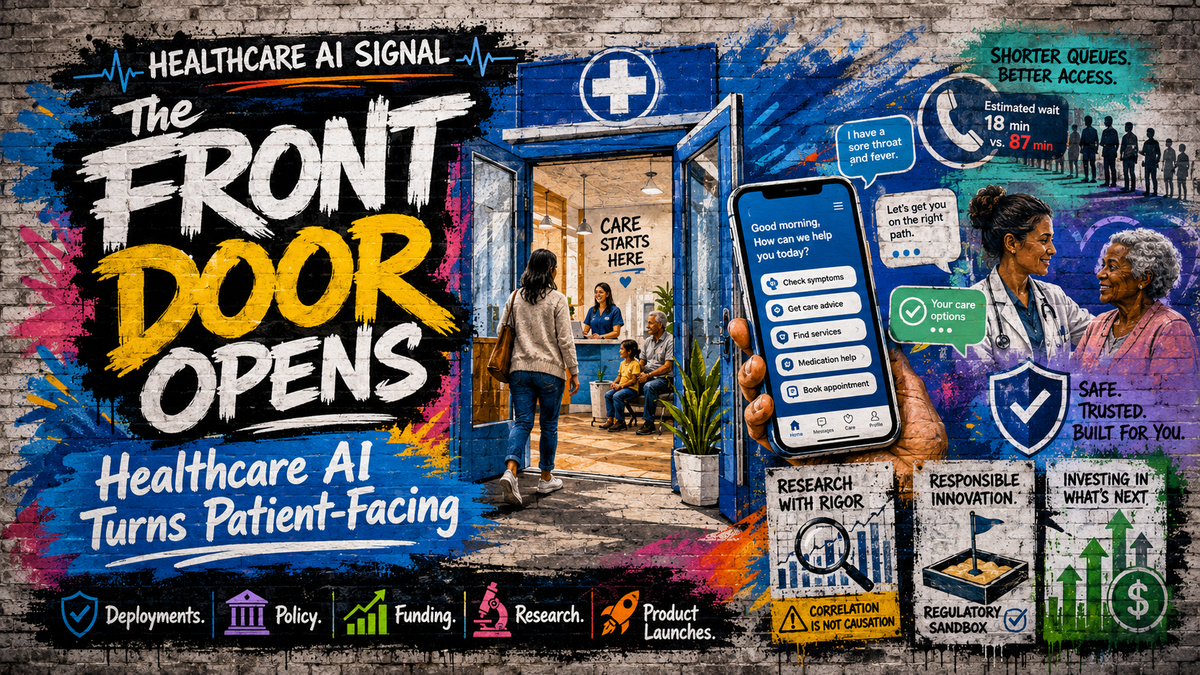
Healthcare AI turned patient-facing this week, at national scale, with dates attached. The NHS committed its patient app to AI triage: 200,000 patients in year one, full availability by April 2028, off a pilot that cut phone queues 29%. Penn Medicine put agentic intake agents in front of live patients, the vendor's second flagship placement in three weeks. WashU and BJC converted a CHAI-vetted, 500-physician ambient pilot into a multi-system rollout, the first scale decision run through a formal assurance framework. For two years, the AI that shipped stayed behind the curtain. The patient never met it. That era ended this week.
Patient-facing AI is the most exposed deployment class in healthcare: it fails in public, and it depends on two things holding, clinicians who trust the tools behind it and data that deserves trust itself. Both cracked this week. Kaiser call-center nurses publicly rejected AI they experience as surveillance. And two widely used training datasets, underpinning hundreds of clinical prediction models, scored zero out of nine on data provenance. The front door is opening faster than the foundations under it are hardening.
Three implications for the quarter. The NHS is now the planning benchmark: a 29% deflection of low-acuity volume changes contact-center staffing before it changes technology budgets. Kaiser makes the architecture lesson concrete: bundle assistance with monitoring and it gets experienced as surveillance, whatever the adoption metrics say. And provenance just became legible liability: any predictive model procured before provenance auditing was standard is uninventoried risk, closable with an attestation clause and a model inventory. The question is no longer whether AI reaches the patient. It is whether the operating discipline behind it is ready to be seen.
1. Signal Summary
- The front door went national. The NHS committed its patient app to AI triage, 200,000 patients in year one and full availability by April 2028, off a Sussex pilot that cut phone queueing 29%.
- Patient-facing agents became a pattern, not an experiment. Penn Medicine put K Health intake agents live in virtual primary care, the vendor's second flagship placement in three weeks after Hartford. No outcome metric yet, so it sits in Market Signals, not Deployments.
- The assurance scaffolding did procurement work. WashU and BJC converted a CHAI-vetted, 500-physician Abridge pilot into a multi-system rollout, the first assurance-framework-vetted scale conversion since the RUAIH certification launched June 1.
- The counter-signals landed together. Kaiser call-center nurses publicly pushed back on AI experienced as surveillance, and QUT researchers showed two widely used Kaggle datasets score 0/9 on data-provenance criteria while underpinning hundreds of clinical models.
- The sandbox thread went higher-autonomy. Israel opened a regulatory sandbox for supervised autonomous medical AI in home and clinical settings, extending the mechanism the UK MHRA launched in June.
- Capital signaled bankability, not hype. Pearl Health raised $110M for Medicare value-based care AI, and the $60M credit facility inside it is the tell: contracted revenue a lender will underwrite.
2. Big Signal of the Week
NHS Commits Its National Patient App to AI Triage: 200,000 Patients in Year One
🔴 Real-World Deployment | Score: 7.3 | View Article
Why It Matters The UK government is adding AI triage to the NHS App to route patients to GP, pharmacy, A&E, or self-care, reaching 200,000 patients in year one with full availability targeted for April 2028, inside a £10bn technology modernization program. The commitment follows a Sussex GP pilot that cut phone queueing by 29%. This is a different move than the staff-side Copilot rollout we covered in June: that deployment pointed AI at the workforce; this one points it at the patient, at national scale, as default infrastructure.
Key Details
- Organization: NHS England, with OneAdvanced and Rapid Health in the triage stack
- Achieved metric: 29% reduction in phone queueing (Sussex GP pilot)
- Commitment: 200,000 patients in year one; full availability by April 2028
- Program: £10bn technology modernization
What This Signals A single-payer system just made AI-first access the default front door for an entire population. Every health system with a phone tree and a portal now has a national-scale reference case for demand routing, and a date by which it will be fully live.
My Read: The 29% queue reduction is the number vendors will quote; the April 2028 date is the number that matters. A government publishing a completion date for population-scale AI triage converts the digital front door from a strategy slide into a schedule, and schedules create procurement pressure in a way pilots never do. For US systems, the transferable question is demand-shaping: if AI routing moves even a fraction of low-acuity volume from GP queues to pharmacy and self-care, the staffing model for access centers changes before the technology budget does. Community health organizations should watch the year-one referral-pattern data closely, because the FQHC front door has the same queue problem with a fraction of the resourcing, and this is the first evidence base big enough to plan against. The question to carry into 2027: does the 29% hold at 200,000 patients, and where does the deflected demand actually land, pharmacy, self-care, or a later, sicker visit?
Source: The Next Web (with EMJ Reviews)
3. Real World Deployments
WashU and BJC Convert a CHAI-Vetted Pilot into a Multi-System Rollout
🔴 Real-World Deployment | Score: 8.2 | View Article
Why It Matters WashU Medicine and BJC Health rolled out Abridge across outpatient clinics after a CHAI-vetted pilot involving nearly 500 physicians, reporting reduced after-hours documentation and cognitive burden. Abridge itself is a familiar name in this briefing, from the nursing GA in May to the platform expansion in June. What is new is the mechanism: this is the first scaled conversion we have seen run through a formal assurance-framework vetting since the Joint Commission and CHAI launched the RUAIH certification on June 1.
Key Details
- Organizations: WashU Medicine, BJC Health, Abridge
- Pilot: Nearly 500 physicians, CHAI-vetted evaluation
- Stage: Multi-system outpatient rollout
- Outcomes: Reduced after-hours documentation, reduced clinician cognitive burden
- Continuity: Abridge nursing GA (May), platform expansion to 300+ systems (June)
What This Signals The accreditation scaffolding we tracked going up in June is now doing procurement work on the ground. Assurance-framework vetting is converting from a compliance concept into the mechanism that gets a scale decision through a board.
My Read: The story is the vetting, not the vendor. When we covered the Joint Commission's RUAIH launch, the open question was whether a voluntary certification would ever touch a real purchasing decision. Five weeks later a flagship academic system is citing CHAI vetting as part of a 500-physician scale conversion. That is the fastest concept-to-procurement cycle any governance instrument has managed in this space, and it hands Abridge a competitive asset: a third-party-validated evidence package it will carry into every enterprise bakeoff. One honest gap: the reported outcomes are directional (reduced after-hours documentation and cognitive burden), not yet quantified; the shift-level number is the thing to request from WashU next quarter. For every other ambient vendor, the bar just moved. For operators, the replicable piece is the evaluation design: a cohort large enough to settle the argument, run through a framework that pre-answers the governance questions that stall scale decisions.
Source: WashU Medicine
4. Market Signals
Penn Medicine Puts Agentic Intake in Front of Live Patients
🟡 Market Signal (held from Deployments: no achieved metric yet) | Score: 7.2 | View Article
Why It Matters Penn Medicine integrated K Health's AI intake agents into its virtual primary care service: collecting symptom and history information, generating structured summaries for clinicians, and triaging simple needs like refills. This is K Health's second flagship placement in three weeks, after Hartford HealthCare's PatientGPT rollout we covered June 30, and the design choices differ in a telling way: Penn is preserving non-AI pathways and gating scale on evaluation.
Key Details
- Organizations: Penn Medicine, K Health
- Workflow: Patient-facing intake, structured summaries, refill triage in virtual primary care
- Stage: Live, early-stage; evaluation before scale; non-AI option preserved; no published performance metric
- Continuity: K Health's second major system in three weeks (Hartford, June 30)
What This Signals Patient-facing agents are moving from one system's experiment to a repeating pattern at flagship providers, and the deployment template is converging: opt-out preserved, evaluation gated, refills first.
My Read: Honest framing first: Penn has published no outcome metric yet, so under the bar this newsletter holds deployments to, this is a live rollout to watch, not a proven result. What earns it the slot is the pattern. Two flagship systems adopting the same vendor's patient-facing agents in a month, with the same guardrail design, is how a category standardizes. Intake is the right first workflow because the failure mode is a clinician re-asking a question, not a patient harmed, and because refill triage is where the labor math lives: refill requests silently consume clinical staff hours in every primary care operation. Penn keeping the non-AI pathway is instrumentation, not hedging; it creates the control group that will make its evaluation data more credible than any vendor study. The number to demand next quarter: refill resolution rate without human touch.
Source: MedCity News
5. Policy and Regulation
Israel Opens a Sandbox for High-Autonomy Medical AI in Home and Clinical Settings
🟡 Policy / Regulation | Score: 7.4 | View Article
Why It Matters Israel's Health Ministry and Innovation Authority launched a regulatory sandbox for supervised real-world pilots of higher-autonomy medical AI, naming three companies: Plessanmore (at-home ultrasound analysis), Cordio Medical (home heart-failure monitoring via voice), and Simhawk (AI-guided fetal weight assessment). It extends the sandbox thread we tracked when the UK MHRA opened two in June, and pushes it further up the autonomy curve, into home settings.
Key Details
- Bodies: Israel Health Ministry, Innovation Authority
- Companies: Plessanmore, Cordio Medical, Simhawk
- Pilots: At-home ultrasound, voice-based heart-failure monitoring, fetal weight assessment
- Continuity: Follows the UK MHRA's two sandboxes (June) and earlier US state sandboxes
- Launched: July 9, 2026
What This Signals The sandbox is becoming the default international mechanism for governing autonomy: regulators generating evidence through controlled deployment rather than gating on pre-market review alone. The autonomy level being sandboxed keeps rising.
My Read: What distinguishes Israel's version is the setting. The MHRA sandboxes test devices and drug-development AI inside institutions; Israel is sandboxing autonomous AI in patients' homes, which is where the liability and monitoring questions are hardest and where the payoff is largest. The three named pilots share a shape worth noticing: each replaces a scarce specialist interaction (sonography, cardiology follow-up, obstetric assessment) with an AI-plus-supervision loop. If the sandbox produces publishable safety data, it becomes the evidence template for home-based autonomous care globally, the same way early clearances became templates for diagnostics. Vendors building toward autonomy should read the cohort selection as a map of what regulators are ready to consider next.
Source: JNS
UK Health Bill Advances Mandatory AI Governance Guidance and Audit Requirements
🟡 Policy / Regulation | Score: 7.3 | View Article
Why It Matters A UK Parliament committee-stage publication dated July 9 contains proposed clauses requiring the Secretary of State to publish guidance within 12 months on governance, monitoring, assurance, and audit of AI systems used in health and care settings, including AI inventories, lifecycle monitoring, processes for responding to performance deterioration, and CQC consideration of the guidance. Where the accreditation moves we covered in June were voluntary, this would be statute.
Key Details
- Body: UK Parliament, committee stage, July 9, 2026
- Requirement: Guidance within 12 months on AI governance, monitoring, assurance, and audit
- Provisions: AI system inventories, lifecycle monitoring, performance-deterioration response processes
- Enforcement hook: CQC consideration of the guidance
What This Signals The governance build-out is crossing from voluntary certification into statutory obligation, with the inspector (CQC) named in the text. AI inventories and lifecycle monitoring are becoming legal expectations, not best practices.
My Read: The clause to price in is the inventory requirement. Most health systems, on both sides of the Atlantic, cannot currently produce a complete list of the AI running in their environment, let alone lifecycle monitoring for each entry. If this passes, NHS trusts get 12 months of runway to build what amounts to an AI asset register with drift response attached, and CQC inspection criteria will make it real. US operators should read this as a preview: the Joint Commission's voluntary RUAIH framework and this statutory UK model are converging on the same artifact list, which means building the inventory now is a hedge that pays in every jurisdiction. Watch the final bill text and the 12-month guidance clock.
Source: UK Parliament (publications.parliament.uk)
6. Controversies and Failures
Kaiser Call-Center Nurses Push Back on AI Experienced as Surveillance
🟡 Controversy / Failure | Score: 6.7 | View Article
Why It Matters Call-center nurses at Kaiser Permanente told The Markup that workplace surveillance tools and AI prioritize speed and cost savings over quality and safety. This lands the same week the front door goes patient-facing, and alongside survey data in this week's dataset showing nurse AI usage tripling to 44% while a trust gap widens: adoption and resistance rising together.
Key Details
- Organization: Kaiser Permanente
- Population: Call-center nurses
- Complaint: Surveillance-adjacent AI tooling prioritizing speed and cost over quality and safety
- Adjacent signal: Nurse survey shows AI usage tripling to 44% alongside a widening trust gap
- Reported: The Markup, July 9, 2026
What This Signals Tools experienced as surveillance generate workforce resistance that no accuracy metric offsets, and the resistance surfaces publicly exactly as deployments scale past pilots.
My Read: This is a design failure masquerading as a labor dispute. When the same tool that assists a nurse also times her, assistance is experienced as surveillance, and the resistance is rational. The fix is architectural: separate the assistive function from the monitoring function, or accept that adoption metrics will lie to you while resentment compounds. The timing sharpens the stakes, because patient-facing AI fails loudly when the clinicians behind it are in revolt. Health systems should audit every deployed tool for monitoring features bundled with assistance, and put workforce-experience instrumentation on the same dashboard as time savings. Watch whether Kaiser or peer systems publish outcome data or adjust surveillance parameters in response.
Source: The Markup
Widely Used Health Prediction Models Rest on Datasets Nobody Can Trace
🟡 Controversy / Failure | Score: 7.1 | View Article
Why It Matters QUT/AusHSI researchers reported that two widely downloaded Kaggle datasets used to build stroke and diabetes risk models lack verifiable provenance and scored 0/9 on TRIPOD+AI data-provenance criteria. The datasets underpin hundreds of publications and some clinical tools. Three weeks after we covered fabricated AI citations contaminating thousands of papers, the evidence base is corroding from two directions at once: references and training data.
Key Details
- Researchers: Queensland University of Technology / AusHSI, published via BMC Medicine
- Finding: Two widely used Kaggle datasets scored 0/9 on TRIPOD+AI data-provenance criteria
- Blast radius: Hundreds of publications and some clinical tools built on the datasets
- Recommendation: Mandatory data-source disclosure and removal of the datasets
What This Signals Data provenance is becoming a non-negotiable prerequisite for deployment, and models built on unverifiable data are liabilities regardless of benchmark performance.
My Read: This is the quieter emergency of the week, and the one to act on this quarter. If your system runs any predictive model procured before provenance auditing was standard, you carry uninventoried risk, and the QUT paper just told every plaintiff's attorney where to look. Two moves: add a data-provenance attestation clause to every AI procurement, which costs a paragraph in an RFP, and run the internal version, inventorying which deployed models trace to public datasets. The structural read is that provenance certification is about to become its own compliance product category; the first vendor to offer TRIPOD+AI-grade dataset audits at scale will find a very motivated market. Watch for payer requirements or accreditor criteria tied to training-data standards.
Source: Medical Xpress (QUT / BMC Medicine)
7. Funding Signals
Pearl Health's $110M: The Debt Tranche Is the Signal
🟡 Funding Signal | Score: 6.7 | View Article
Why It Matters Pearl Health raised $110M, a $50M equity round led by Andreessen Horowitz plus a $60M credit facility, to expand its AI population-health platform into Medicare Advantage and new risk offerings. In a week where the other new capital signals were modest, the structure of this raise says more than the size.
Key Details
- Company: Pearl Health
- Structure: $50M equity (Andreessen Horowitz lead) plus $60M credit facility
- Use: Medicare Advantage expansion, new risk offerings, enterprise payer and health-system partnerships
- Category: Medicare value-based care AI
What This Signals Debt financing signals contracted, predictable revenue. Value-based care AI just crossed from venture thesis to bankable business model, and that reprices the segment.
My Read: Credit facilities are underwritten against cash flows, not narratives, so a $60M facility tells you Pearl's risk-bearing economics are predictable enough for a lender, which is a stronger validation than the equity round it rode in on. The strategic timing matters too: MA expansion in the same season that federal scrutiny of payer-side AI keeps hardening means Pearl is betting that provider-enablement AI, helping physicians succeed under risk, sits on the safe side of the regulatory line that autonomous denial tools sit on the wrong side of. That is probably right, and it defines the investable wedge in Medicare AI: tools that help providers manage risk are compliance-tailwinded; tools that help payers deny claims are compliance-headwinded. Sort every Medicare AI pitch into one of those two buckets before reading the deck.
Source: MobiHealthNews
8. Research Breakthroughs
AI Ultrasound Model Generalizes Across Clinical Environments for Gestational Age
🟡 Research Breakthrough | Score: 7.1 | View Article
Why It Matters A JAMA Network Open multicenter diagnostic study (385-participant primary evaluation set) showed an AI model estimating gestational age from blind-sweep ultrasound achieved a mean absolute error of roughly 4.2 days and was noninferior to the clinical standard across sites in Chicago and Nairobi. The capability echoes the Butterfly clearance arc from the spring; the new evidence is cross-environment robustness, the property most imaging AI never proves.
Key Details
- Publication: JAMA Network Open, July 9, 2026
- Parties: Google, Jacaranda Health, Northwestern University, Clarius
- Design: Multicenter diagnostic study, 385-participant primary evaluation set
- Result: Mean absolute error ~4.2 days; noninferior to clinical standard across Chicago and Nairobi sites
What This Signals Validation is moving beyond single-site benchmarks toward evidence of cross-environment robustness, and buyers should treat external generalization as a core selection criterion rather than assuming site-specific retraining.
My Read: The Chicago-and-Nairobi design is the point. A model that holds noninferiority across a US academic environment and a Kenyan maternal-health setting has demonstrated the property that kills most imaging AI in the field: sensitivity to the site it was trained on. For procurement teams, this study hands you a new vendor question that costs nothing to ask: show me your cross-environment evaluation, not your best-site AUC. For the access story, blind-sweep protocols that work without a trained sonographer are how prenatal imaging reaches rural markets, and the workforce math there is the same in Tennessee as in Nairobi. Watch for workflow-integration studies measuring time and diagnostic yield in routine practice.
Source: JAMA Network Open
AI-Designed Molecule Enters Phase III, Adding Clinical Evidence for Discovery Platforms
🟡 Research Breakthrough | Score: 7.2 | View Article
Why It Matters Insilico Medicine's rentosertib, a molecule with an AI-identified target and AI-generated chemistry, entered a Phase III trial for idiopathic pulmonary fibrosis, supported by a Takeda collaboration worth up to roughly $600M. It lands three months after Lilly's $2.75B Insilico platform deal, converting that platform bet into a clinical-stage receipt.
Key Details
- Companies: Insilico Medicine, Takeda
- Asset: Rentosertib, Phase III, idiopathic pulmonary fibrosis
- Deal: Takeda collaboration up to ~$600M
- Continuity: Follows Lilly's $2.75B Insilico platform access deal (April)
- Caveat: Readouts are years away; the field still lacks an approved AI-originated drug
What This Signals AI discovery platforms are being priced by pipeline stage distribution, and each phase transition de-risks the platform, not just the asset. Two major pharmas have now independently priced the same platform within a quarter.
My Read: Insilico is running the most legible strategy in AI discovery: convert platform credibility into partnership capital, convert partnership capital into clinical milestones, and let each milestone raise the price of the next partnership. Lilly plus Takeda in one quarter means pharma BD teams are now bidding against each other for access, and that auction dynamic, not any single molecule, is what changed the category's economics. The honest caveat stands: Phase III entry is not Phase III success, and IPF is a graveyard indication. But the competitive read for the rest of the field is uncomfortable: the platform-consolidation thesis from the spring is playing out, and mid-cap discovery vendors without a clinical-stage asset or a top-10 pharma anchor are running out of quarters to get one.
Source: Corewire
Multi-Agent LLMs Show Early Ability to Emulate Clinical Trial Design on Real-World EHR Data
🟡 Research Breakthrough | Score: 7.2 | View Article
Why It Matters Weill Cornell Medicine researchers described EmulatRx, an AI system that simulates collaborative expert reasoning to design and optimize clinical trials using real-world EHR data, published July 7 in Nature Communications. It attacks trial design the way the recruitment and synthetic-control tools we covered in May attacked their halves of the bottleneck: with a validated system rather than a benchmark claim.
Key Details
- Institution: Weill Cornell Medicine
- System: EmulatRx, multi-agent LLM simulation of collaborative trial-design reasoning
- Data: Real-world EHR data
- Publication: Nature Communications, July 7, 2026
- Continuity: Joins the trial-recruitment and synthetic-control AI evidence covered in May
What This Signals AI is progressing from model benchmarks toward simulation layers that could compress trial-design cycles while retaining human oversight, and the trial pipeline now has AI evidence at three separate stages: design, recruitment, and controls.
My Read: The trial bottleneck is being attacked in pieces, and the pieces are starting to meet. Recruitment got its peer-reviewed 7x lift in May, synthetic controls got their production validation the same month, and design, the stage upstream of both, now has a published multi-agent system. For academic medical centers competing for industry-sponsored trials, the composite is the story: sponsors will soon evaluate sites on an AI-enabled trial stack, not a single capability. The measured caveat is that EmulatRx is early, and the metric that matters, reduced design time or amendment rates in a real protocol, has not been demonstrated. Research operations leaders should track it as a future input to protocol design, and position for the multicenter prospective validation that decides whether it becomes one.
Source: Weill Cornell Medicine Newsroom (Nature Communications)
9. Trend to Watch: The Front Door Opens Faster Than Trust Closes Behind It
The week's signals line up on one axis: healthcare AI is turning patient-facing faster than the trust infrastructure underneath it is hardening. On one track, the NHS put a date on population-scale triage and flagship US systems standardized a patient-facing intake template. On the other, the workforce that patient-facing AI depends on pushed back publicly at Kaiser, and the evidence base itself took a provenance hit that implicates hundreds of models.
These tracks are connected, and the connection is operational. Patient-facing AI is the most exposed deployment class there is: it fails in front of the customer, it depends on clinicians trusting the tools behind it, and it inherits every weakness in the data it was built on. The systems that will scale it successfully are the ones treating workforce experience and data provenance as deployment infrastructure, instrumented as rigorously as time savings, rather than as compliance afterthoughts. Watch three things through Q3: the NHS year-one referral-pattern data, the first published refill-resolution or deflection metric from a US patient-facing agent deployment, and whether provenance attestation starts appearing in RFP language. The first vendor and the first operator to publish on each will set the bar the rest of the category answers to.
10. Signal Scoreboard: Top 10
Ranked by Signal Strength Score. Week of July 5–11, 2026. Previously covered stories excluded; deployments without achieved performance metrics held.
- WashU and BJC Convert a CHAI-Vetted Pilot into Multi-System Abridge Rollout | 8.2 | Deployment. First assurance-framework-vetted scale conversion since RUAIH launched.
- Israel Launches Regulatory Sandbox for Supervised Autonomous Medical AI | 7.4 | Policy. Three companies pilot high-autonomy AI in home and clinical settings.
- UK Health Bill Advances Mandatory AI Governance and Audit Requirements | 7.3 | Policy. Committee-stage clauses require AI inventories, lifecycle monitoring, and CQC consideration.
- NHS Commits National AI Triage with 200k-Patient Year-One Rollout | 7.3 | Deployment. Sussex pilot cut phone queueing 29%; full availability targeted April 2028.
- AI-Designed Molecule Enters Phase III for Idiopathic Pulmonary Fibrosis | 7.2 | Research. Insilico's rentosertib advances with a Takeda collaboration worth up to ~$600M.
- Penn Medicine Deploys Agentic AI Intake in Live Virtual Care | 7.2 | Market. K Health's second flagship placement in three weeks; no outcome metric published yet.
- Multi-Agent LLMs Emulate Clinical Trial Design on Real-World EHR Data | 7.2 | Research. Weill Cornell's EmulatRx published in Nature Communications.
- AI Ultrasound Model Generalizes Across Clinical Environments for Gestational Age | 7.1 | Research. Noninferior to clinical standard across Chicago and Nairobi sites.
- Poor Training Data Quality Threatens Health Prediction Models | 7.1 | Controversy. Widely used Kaggle datasets scored 0/9 on TRIPOD+AI provenance criteria.
- Kaiser Nurses Push Back on AI and Surveillance Tooling | 6.7 | Controversy. Front-line resistance surfaces as deployments scale.
11. Noise of the Week
White House AI Executive Order Points to Rising Compliance Burden for Healthcare
⚪ Noise | Score: 4.5 | View Article
Why It Looks Important An executive order on AI innovation and security sounds like it should change healthcare compliance obligations, and law-firm alerts are treating it that way.
Why It Is Actually Noise No named agency actions, no reimbursement changes, no operational mandates for healthcare organizations. Directional intent filtered through legal commentary. The federal moves that actually bind, the offices, the appropriations votes, the procurement bakeoffs, have all been institutional, and all previously covered. This is atmosphere.
Source: Sheppard Mullin (law firm alert)
GE Extends Legacy Imaging Lifespan via AI Upgrade Pathways
⚪ Noise | Score: 4.5 | View Article
Why It Looks Important AI reconstruction, AR guidance, and predictive maintenance layered onto existing Innova and Discovery suites reads like an immediate capital-planning consideration, and GE sits atop the FDA radiology clearance league table we covered in June.
Why It Is Actually Noise Vendor announcement with no named customers, no deployments, no measured outcomes. The installed-base defense strategy is real and consistent with the incumbent-consolidation pattern; there is just nothing yet for an operator to evaluate.
Source: Insider Monkey (industry report)