
Governance Got an Org Chart
Week of June 7-13, 2026
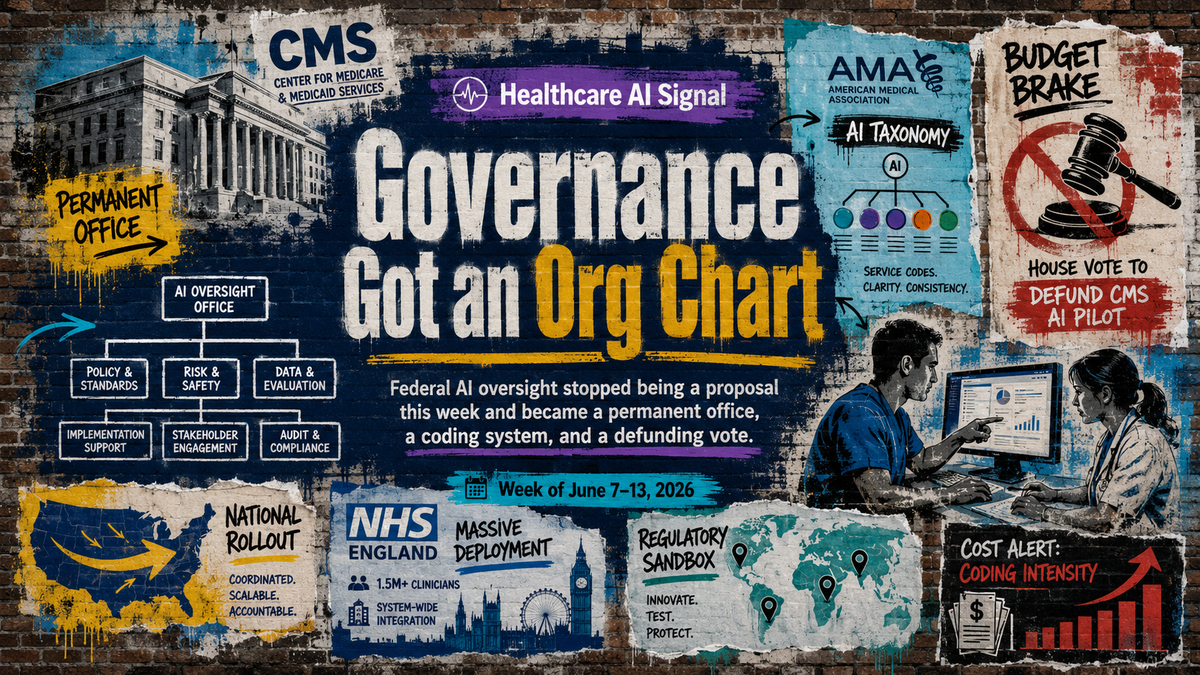
Federal AI oversight stopped being a proposal this week and became a permanent office, a coding system, and a defunding vote.
In this newsletter we have tracked the rules "arriving" since March. Governance as scale advantage in March, the new reimbursement rules in April, the carrot and the stick in late April, the federal floor moving down in May. The recurring word was arriving. This week the rules stopped arriving and started becoming permanent. CMS stood up a standing office with budget and reporting lines. The AMA gave AI services a coding taxonomy. The House used appropriations to kill a CMS pilot outright. Last week's issue marked the autonomy threshold, AI acting without a clinician in the loop. This week is the other half of that story: the bureaucracy being built to govern the thing that just learned to act on its own. The difference between a proposal and an office is permanence and a line in the budget. Both showed up this week.
1. Signal Summary
- Federal AI governance got a permanent home. CMS created the Office of Health Technology and Products (OHTP), the standing institution that was missing after AERO turned Medicaid dollars into an audit lever and OCR restructured around AI-HIPAA enforcement, both covered in May.
- Congress used the budget as a brake. The House Appropriations Committee voted to defund the CMS WISeR AI prior-authorization pilot. We have tracked WISeR since its April launch and through the Cantwell inquiry; this week the threat became an appropriations action.
- Reimbursement got a taxonomy. The AMA published an assistive-to-autonomous classification for AI services, the coding plumbing for exactly the autonomy spectrum we flagged last week.
- Deployment hit national scale. NHS England committed 505,000 staff to Microsoft Copilot on the strength of 43 minutes saved per worker per day, the largest operational AI rollout in healthcare to date.
- The accreditation regime is now real. Following the Joint Commission certification we noted last week, the UK MHRA opened two regulatory sandboxes, extending the structured-oversight build-out internationally.
- A darker cost signal surfaced. PwC and Blue Cross Blue Shield data show ambient documentation tools are raising coding intensity and billed severity before delivering net savings, the uncomfortable sequel to the Mercy revenue-lift story we ran in April.
Healthcare AI Signal
Governance Got an Org Chart
Federal AI oversight stopped being a proposal this week and became a permanent office, a coding system, and a defunding vote.
Week of June 7-13, 2026
This newsletter has tracked the rules "arriving" since March. Governance as scale advantage in March, the new reimbursement rules in April, the carrot and the stick in late April, the federal floor moving down in May. The recurring word was arriving. This week the rules stopped arriving and started becoming permanent. CMS stood up a standing office with budget and reporting lines. The AMA gave AI services a coding taxonomy. The House used appropriations to kill a CMS pilot outright. Last week's issue marked the autonomy threshold, AI acting without a clinician in the loop. This week is the other half of that story: the bureaucracy being built to govern the thing that just learned to act on its own. The difference between a proposal and an office is permanence and a line in the budget. Both showed up this week.
1. Signal Summary
- Federal AI governance got a permanent home. CMS created the Office of Health Technology and Products (OHTP), the standing institution that was missing after AERO turned Medicaid dollars into an audit lever and OCR restructured around AI-HIPAA enforcement, both covered in May.
- Congress used the budget as a brake. The House Appropriations Committee voted to defund the CMS WISeR AI prior-authorization pilot. We have tracked WISeR since its April launch and through the Cantwell inquiry; this week the threat became an appropriations action.
- Reimbursement got a taxonomy. The AMA published an assistive-to-autonomous classification for AI services, the coding plumbing for exactly the autonomy spectrum we flagged last week.
- Deployment hit national scale. NHS England committed 505,000 staff to Microsoft Copilot on the strength of 43 minutes saved per worker per day, the largest operational AI rollout in healthcare to date.
- The accreditation regime is now real. Following the Joint Commission certification we noted last week, the UK MHRA opened two regulatory sandboxes, extending the structured-oversight build-out internationally.
- A darker cost signal surfaced. PwC and Blue Cross Blue Shield data show ambient documentation tools are raising coding intensity and billed severity before delivering net savings, the uncomfortable sequel to the Mercy revenue-lift story we ran in April.
2. Big Signal of the Week
CMS Creates OHTP to Formalize AI Governance Across Medicare and Medicaid
🔴 Major Signal | Score: 8.3 | View Article
Why It Matters For three months this briefing has cataloged federal AI moves that were powerful but provisional. AERO was an initiative. The OCR restructure was a reorganization. The Health Tech Ecosystem was a showcase. WISeR was a pilot. What none of them had was a permanent address on the org chart. OHTP is that address. An office with budget and staff does not expire when the news cycle moves on, and it does not need a fresh executive order to keep operating. This is the moment federal healthcare AI policy stopped being a series of moves and became a standing function.
Key Details
- Organization: Centers for Medicare and Medicaid Services
- Office: Office of Health Technology and Products (OHTP), effective June 9, 2026
- Scope: technology modernization, digital product strategy, interoperability, and AI implementation across Medicare and Medicaid
- Independent confirmation: American Hospital Association and Healthcare Dive
- Reported: Becker's Payer Issues, June 12, 2026
What This Signals Whoever shapes OHTP's first frameworks shapes the cost of compliance for every vendor selling into government programs. Interoperability and procurement standards set here will cascade into commercial contracts, because no serious vendor will build two architectures.
My Read: Read this as the next beat in the federal-consolidation story, not its first chapter. For months the levers were scattered: AERO for audits, OCR for enforcement, reimbursement codes for payment, WISeR for prior auth. None had a permanent home to coordinate them. OHTP is the natural place that consolidation happens, which makes its opening moves the thing to watch. The office is more consequential than any single rule it will eventually issue, because the office outlives the rules.
Source: Becker's Payer Issues
3. Real-World Deployments
We applied a strict filter this section, the same one we have used since day one: only deployments with documented achieved outcomes at the named operator. Two widely covered items were held this week for failing that bar, noted at the end.
NHS England Scales Copilot to 500k Staff After Measured Admin Time Savings
🔴 Real-World Deployment | Score: 8.2 | View Article
Why It Matters This is the largest operational AI deployment in healthcare on record, and it is justified by a measured number rather than a projection. The 43-minute daily savings came out of a real trial across 90 organizations before the rollout decision, which is the opposite of the announce-first-measure-later pattern that fills most deployment coverage.
Key Details
- Organization: NHS England
- Tool: Microsoft 365 Copilot
- Scale: 505,000 clinicians and support staff
- Evidence base: trial of more than 30,000 workers across 90 organizations
- Achieved metric: roughly 43 minutes saved per person per day
- Announced: June 8, 2026
What This Signals National-scale deployment is now the operator benchmark. A horizontal productivity layer standardized across an entire national system is a different category than the Epic inbox tools at 250 systems we covered in May.
My Read: The number that matters is 43 minutes, because it is achieved, not promised. The risk is the one we flagged in "From Pilot to Practice": recovered minutes only show up on a dashboard if they are deliberately reallocated, into patient time, reduced overtime, or different acuity ratios. Otherwise they dissolve back into the workload and nothing moves. Watch the October adoption numbers and whether the savings hold at 505k, because trial savings and at-scale savings are different animals.
Source: NHS England
Hackensack Shows Virtual Nursing with Epic Delivering Safety and Staffing Gains
🟡 Real-World Deployment | Score: 7.6 | View Article
Why It Matters This is the rare virtual-care story that touches a safety line and a labor line at the same time, with achieved numbers rather than activation counts. It is the third virtual-nursing deployment we have covered, and unlike a press release, it comes with documented outcomes that earn the slot.
Key Details
- Organization: Hackensack University Medical Center
- Vendor and integration: AvaSure virtual nursing, integrated with Epic
- Achieved outcomes: reduced falls and catheter-associated infections, lower traveler-nurse utilization, improved length of stay
- Prior coverage in this category: UCHealth virtual ICU (April), Sentara 70,000 encounters (May)
What This Signals Virtual care has crossed from isolated pilots into EHR-integrated operational tools that move safety metrics and labor economics together.
My Read: Documentation reduction stories saturated 2025. What separates this one is that the outcomes are clinical and financial at once: fewer falls and infections on one side, fewer traveler nurses and shorter stays on the other. Any system still running this category as a pilot now has a named peer with booked numbers. The open question is multi-site durability, which is exactly what Hackensack Meridian says it will publish next.
Source: Healthcare Innovation
King Faisal Specialist Hospital Reports Gains from 20 Internally Built AI Tools
🟡 Real-World Deployment | Score: 7.4 | View Article
Why It Matters A large system is building proprietary operational AI rather than depending only on vendors, and it is reporting measurable operational gains, not a roadmap. This is the build-versus-buy signal in the spirit of the Phoenix Children's internal-build story, at national-referral-center scale.
Key Details
- Organization: King Faisal Specialist Hospital and Research Centre
- Unit: Centre for Healthcare Intelligence
- Scope: roughly 20 internally developed AI applications across medical imaging and patient flow
- Reported outcomes: measurable throughput and capacity gains via a Patient Flow and Capacity Command Centre
- Venue: HLTH Europe 2026, June 11, 2026
- Caveat: outcomes are self-reported in a press release, pending independent confirmation
What This Signals Systems with the data-engineering capacity to build are opening a second path that vendor roadmaps do not control.
My Read: The interesting part is not any single tool, it is the command-center pattern: a system pulling 20 internal applications into a single operational layer for capacity and flow. That is infrastructure, not a feature. The honest qualifier is the source. Self-reported gains in a conference press release are direction, not proof, until someone independent confirms the throughput numbers. Treat it as a credible build signal with an asterisk.
Source: GlobeNewswire / KFSH
Editorial note, deployments held this week: Hartford HealthCare's PatientGPT (Score 7.8) is a live patient-portal deployment, but the available reporting cites governance and activation, not performance or outcome metrics. UCLA Health's new pre-deployment AI validation center (Score 7.3) is a capability stand-up with no published evaluations yet. Both are real and strategically interesting. Neither has documented results at the named operator, so they wait. This is the same filter we applied to MetroHealth, Apollo, and the BMS Claude rollout in prior issues.
4. Market Signals
Abridge Extends Ambient AI from Documentation into Clinical and Revenue Workflows
🟡 Market Signal | Score: 7.6 | View Article
Why It Matters We have followed Abridge from HonorHealth's 500-clinician wave rollout in April to its seat in the HTI-1 pushback coalition in May. This week it stopped being a scribe vendor. The platform expansion is a move to own the full clinical encounter, from documentation through decision support and billing, rather than a single point in it.
Key Details
- Organization: Abridge
- Announcement: AI-native clinician intelligence platform, New York City keynote, June 11, 2026
- Scope: clinical-conversation foundation model, pre-visit preparation, revenue-cycle features
- Live footprint: more than 300 health systems
- Named ecosystem: NVIDIA, Northwestern Medicine, Eli Lilly, UCHealth
What This Signals Ambient AI is consolidating into platform layers that own the encounter, not point tools for scribing.
My Read: The control-point math is the story. A scribe captures the conversation; a platform that adds pre-visit prep and revenue-cycle features captures the documentation, the decision, and the bill. If your current ambient vendor cannot follow you up that stack, your leverage shrinks every quarter. Watch for measured reductions in documentation time or denial rates at named sites, because the platform claim needs achieved numbers to hold.
Source: Business Wire
Radiology Partners Scales AI-Native Real-Time Reporting Across Thousands of Radiologists
🟡 Market Signal | Score: 7.4 | View Article
Why It Matters The reporting layer is the operational control point in imaging, and two large operators moved to claim it within days of each other. When incumbents embed foundation models into the core interpretation workflow rather than bolting on assistive tools, the competitive front line shifts.
Key Details
- Organizations: Radiology Partners, Mosaic Clinical Technologies
- Capability: foundation-model ambient reporting embedded in existing interpretation workflows
- Scale: thousands of radiologists
- Parallel move: RadNet's DeepHealth unit launched a competing AI reporting platform the same week
What This Signals Large physician groups and imaging operators are embedding foundation models into core diagnostics, claiming the workflow layer before startups can.
My Read: In high-volume service lines, whoever owns the workflow layer owns the margin, and the incumbents now understand that as well as the startups do. The fact that Radiology Partners and RadNet moved in the same week is the signal: this is a land grab for the reporting control point, not a coincidence. The missing piece, as everywhere this week, is published productivity or accuracy data from the live workflow. Direction is clear; proof is pending.
Source: Business Wire / Mosaic Clinical Technologies
5. Policy and Regulation
House Blocks CMS Funding for the WISeR AI Prior-Authorization Pilot
🔴 Policy / Regulation | Score: 8.2 | View Article
Why It Matters We have tracked WISeR through three stages: launch in April, the Cantwell-led congressional inquiry in late April, and MACPAC's oversight pressure in May. This week it reached the stage that matters, an appropriations vote. Inquiries can be ignored. A funding prohibition cannot. This is the first time Congress has used the budget to stop a federal healthcare AI program outright.
Key Details
- Body: House Appropriations Committee
- Action: unanimous vote to bar CMS from spending on the WISeR AI prior-authorization pilot
- Cited concerns: program delays, transparency gaps, risks to patient care
- Program: WISeR (Wasteful and Inappropriate Service Reduction), AI prior auth in traditional Medicare
What This Signals AI in high-stakes administrative workflows now faces legislative scrutiny earlier and harder than the agency-pilot stage, with funding risk attached.
My Read: AI prior authorization remains the most politically exposed AI category in healthcare, and this is the proof. The pattern we predicted in April held: cost-savings claims meet patient-access concerns, lawmakers amplify, and the program ends up defended in an appropriations markup. Any vendor or system with a Medicare prior-auth AI roadmap should reprice the political risk now. Watch whether the prohibition survives final appropriations or spreads to other CMS AI initiatives.
Source: Global Relay Intelligence and Practice
AMA Taxonomy Creates a Coding Framework from Assistive to Autonomous AI
🟡 Policy / Regulation | Score: 7.8 | View Article
Why It Matters Last week's "Autonomy Threshold" marked AI crossing from assistant to licensed operator. This is the reimbursement plumbing for that exact spectrum. An official taxonomy that sorts AI services by autonomy level directly informs CPT coding, and coding is where reimbursement, payer scrutiny, and liability get decided.
Key Details
- Organization: American Medical Association
- Framework: three-tier taxonomy, assistive, augmentative, and autonomous
- Location: CPT Appendix S
- Purpose: guide coding decisions and downstream payment, compliance, and liability
What This Signals Healthcare AI is moving from ad-hoc pilots toward structured reimbursement pathways where the autonomy level determines coding eligibility and payer scrutiny.
My Read: This is the quiet companion to every autonomy story we have run. Flok's licensed AI physiotherapist last week raised the question of who pays and who is liable when AI acts alone; the AMA taxonomy is the start of the answer. Map your current and planned tools against the three tiers now, because where a tool lands will determine its coding and the documentation burden that comes with it. Watch for the specific CPT codes and payer coverage determinations that assign payment by tier.
Source: American Medical Association
UK MHRA Opens Regulatory Sandboxes for AI Devices and Drug Development
🟡 Policy / Regulation | Score: 7.8 | View Article
Why It Matters The structured-oversight build-out is going international. Following the CARF-to-Joint-Commission accreditation arc we have tracked since April, regulators are now standing up controlled evidence-generation programs rather than relying on guidance alone. The MHRA opened two sandboxes in a single week, one for AI medical devices and one for AI in medicines development.
Key Details
- Organization: UK Medicines and Healthcare products Regulatory Agency
- Partners: NHS England (London), London Health Innovation Networks
- Device sandbox: real-world testing for up to 10 AI medical devices, published June 10, 2026
- Drug-development sandbox: up to 5 AI approaches for drug safety and pharmacokinetics, June 9, 2026
What This Signals Regulators are shifting from pre-market review toward structured real-world evidence programs to manage AI risk and speed adoption.
My Read: Sandboxes are the regulatory equivalent of a controlled deployment: a way to generate compliance evidence without betting the whole market on a single approval pathway. For device makers targeting the UK, this changes the prep work, evidence packages built for sandbox-style testing rather than traditional trials alone. The signal to watch is the first cohort, because the approaches the MHRA selects will telegraph where it thinks the risk and the opportunity sit.
Source: GOV.UK (MHRA)
The US state patchwork also advanced. Colorado exempted HIPAA-covered entities from its AI law (Score 7.6), while other states moved on prior-auth reporting and chatbot restrictions (Score 7.2). This continues the fragmentation thread rather than breaking new ground; the compliance takeaway is unchanged, multi-state operators need a centralized AI compliance function, not workflow-by-workflow legal review. Separately, a state attorney general coalition subpoenaed OpenAI over health-data handling (Score 7.2), the next concrete action after the scrutiny we noted in May.
6. Funding Signals
Triomics Raises $22M Tied to Named Oncology Deployments at MSK, MD Anderson, and Yale
🟡 Funding Signal | Score: 7.8 | View Article
Why It Matters This is the funding signal worth weighting: a round explicitly linked to live use at multiple flagship cancer centers, not a roadmap. After Cleveland Clinic's peer-reviewed 7x trial-matching lift in May and Optellum's reimbursed lung-cancer scale last week, capital is concentrating on oncology AI that can show named-site proof.
Key Details
- Organization: Triomics
- Round: $22M Series B, led by Battery Ventures, announced June 9, 2026
- Named centers: Memorial Sloan Kettering, MD Anderson, Yale Cancer Center, Texas Oncology
- Use cases: clinical trial matching, pre-visit chart preparation, chart abstraction
What This Signals Oncology AI is advancing from pilots into production workflows that replace manual chart review at leading centers, and buyers are paying for the operational ROI.
My Read: For operators, a named-deployment funding round doubles as vendor diligence: someone credible already bought it and put it into production. The pattern across three weeks of oncology funding is consistent, capital follows live workflows at flagship centers, not demos. The thing still missing, here as with Optellum, is independent outcome data from the deployed sites. Volume and adoption are necessary; published outcomes are what settle a category.
Source: Healthcare IT Today
Stepful Raises $55M Series C with Health-System Backers for Workforce Training
🟡 Funding Signal | Score: 6.7 | View Article
Why It Matters The workforce gap is the constraint AI cannot code around, so capital is moving upstream into building the workforce itself. What makes this round notable is who is in it: four major operators co-invested alongside the venture firms.
Key Details
- Organization: Stepful
- Round: $55M Series C
- Operator co-investors: Intermountain Health, Mount Sinai, Ochsner, Providence
- Venture backers: Oak HC/FT, Foresite Capital, and others
- Focus: AI-enabled clinical workforce training at scale
What This Signals Investors and operators alike are treating workforce capacity, not just clinical tooling, as a core AI investment thesis.
My Read: When peer operators put their own money into a vendor, treat it as field-tested validation rather than a financing event. Health systems do not co-invest in training platforms for the optics; they do it because the shortage is the binding constraint on everything else, including AI adoption itself. The read for other operators is that workforce-capacity AI just got a buy signal from inside the tent.
Source: The AI Insider
Ilant Health Raises $15M for AI-Supported Value-Based Obesity Care
🟡 Funding Signal | Score: 6.4 | View Article
Why It Matters GLP-1 demand created a coordination problem worth solving, and capital is backing AI-supported value-based models to solve it. This is the GLP-1 adjacency becoming its own investable category.
Key Details
- Organization: Ilant Health
- Round: $15M Series A
- Focus: AI-supported, value-based obesity and GLP-1 management
- Model: precision care replacing fragmented obesity workflows
What This Signals The GLP-1 era is spawning a dedicated layer of AI-enabled value-based care companies positioned on coordination and cost.
My Read: The thesis is sound on paper: GLP-1 demand is enormous, the care around it is fragmented, and a value-based model that coordinates it could capture real savings. The proof point this category still owes is demonstrated savings, not enrolled lives. Watch whether Ilant and its peers can publish cost outcomes, because value-based claims live or die on the economics.
Source: Healthcare IT Today
7. Research Breakthroughs
Stanford Pilot Validates AI Discharge Summaries in Live Workflow with Low Error Risk
🟡 Research Breakthrough | Score: 7.3 | View Article
Why It Matters Discharge summaries are a high-volume, bounded documentation task with a clean risk profile, which makes them a defensible first target for clinical AI. A peer-reviewed pilot showing burnout reduction with an acceptable safety profile is the kind of evidence procurement teams can act on.
Key Details
- Organization: Stanford Medicine / Stanford Health Care
- Tool: MedAgentBrief, an AI-enabled documentation agent
- Use case: discharge summaries
- Outcomes: reduced physician burnout, mostly safe summaries with some omissions and inaccuracies flagged
- Publication: JAMA Network Open (May 8), reported June 8, 2026
What This Signals AI is moving from model benchmarks to validated tools for replacing specific clinical administrative labor in operational settings.
My Read: Stanford has shown up repeatedly in recent issues for admin AI utilization and inbox time savings; this extends the pattern into a clinical-documentation use case with published evidence and a named safety profile. The lesson for operators is sequencing: start where the risk is bounded and the burnout is real, earn clinician trust, then expand. The honest part of this study is that it names its own omissions, which is what separates a pilot worth trusting from a press release.
Source: Stanford Medicine News Center
Proposed MEDS Standard Targets Inconsistent EHR Data as the Core Barrier to Reliable Health AI
🟡 Research Breakthrough | Score: 7.1 | View Article
Why It Matters A multicenter proposal argues that data formatting and exchange inconsistency, not model architecture, is the binding constraint on reliable health AI. That reframes the bottleneck from algorithms to plumbing, the same diagnosis Intermountain made about standardized data in March, now formalized as a proposed standard.
Key Details
- Source: MIT Jameel Clinic, multicenter authorship
- Proposal: Medical Event Data Standard (MEDS), a common format for health events
- Publication: NEJM AI
- Target problem: inconsistent EHR data that undermines model reliability and reuse
What This Signals Healthcare AI progress is increasingly constrained by foundational data infrastructure rather than model capability alone.
My Read: This is the unglamorous fight that decides who actually scales. A model is only as good as the data exchange feeding it, and most systems underinvest in standards precisely because the payoff is invisible until something breaks. A common event standard, if it gains traction, is the kind of infrastructure that quietly advantages whoever adopts it early. Watch which systems and vendors sign on, because that is where durable advantage gets built.
Source: MIT Jameel Clinic (NEJM AI)
Commercial Mammography AI Flags Future Cancer Risk Up to Six Years Early
🟡 Research Breakthrough | Score: 6.8 | View Article
Why It Matters Three existing commercial AI-CAD systems surfaced longitudinal risk signals years before diagnosis on a large retrospective dataset. That shifts imaging AI from snapshot detection toward continuous risk stratification, echoing Mayo's pre-diagnostic pancreatic work from May in a different cancer.
Key Details
- Organizations: Karolinska University Hospital, study published in Radiology (RSNA)
- Finding: three commercial AI-CAD tools associated with elevated risk scores up to six years pre-diagnosis
- Data: large retrospective curated dataset
- Domain: breast cancer screening
What This Signals Imaging AI is moving from per-exam lesion detection toward longitudinal risk modeling that could reshape screening intervals and resource planning.
My Read: The structural implication is bigger than the accuracy figure. If existing commercial tools can surface risk years ahead on retrospective data, the screening question changes from "what did this scan show" to "what does this patient's trajectory show." That reshapes intervals, resourcing, and follow-up. The qualifier is the word retrospective. This needs prospective validation before it changes a protocol, but the direction is clear and the tools already exist.
Source: PR Newswire (RSNA / Radiology)
8. Trend to Watch
The connective tissue this week is permanence. For three months, federal and state action on healthcare AI took provisional forms: pilots, initiatives, proposed rulemaking, reorganizations, executive enthusiasm. Provisional things can be paused, defunded, or reversed with the next administration or the next news cycle. What arrived this week is different in kind. An office has tenure. A coding taxonomy becomes infrastructure the moment payers reference it. A unanimous appropriations vote is a precedent that outlives the committee that cast it. An accreditation standard becomes the template every peer accreditor copies, exactly as we predicted CARF would propagate, and as the Joint Commission proved last week.
The strategic read is that the cost of treating AI governance as a compliance afterthought just went up structurally, not incrementally. When the rules were proposals, a fast-moving health system could deploy ahead of them and adjust later. When the rules are an office, a code set, and a budget line, that arbitrage closes. The organizations that win the next 18 months will treat governance posture as a product surface they design on purpose: a standing validation function, a tiering of their AI portfolio against the AMA taxonomy, a procurement standard that anticipates OHTP. The institutions governing healthcare AI became permanent this week. The smart move is to build your own permanent institutions to meet them, before they are built for you.
9. Signal Scoreboard
Top 10 stories cleared for publication, ranked by Signal Score. Week of June 7-13, 2026.
- CMS Creates OHTP for AI Governance | 8.3 | Policy First permanent federal home for AI oversight
- House Blocks CMS WISeR Prior-Auth Funding | 8.2 | Policy Appropriations becomes a brake on agency AI
- NHS Scales Copilot to 500k Staff | 8.2 | Deployment Largest operational AI rollout on record
- AMA AI Coding Taxonomy | 7.8 | Policy Autonomy tier will drive reimbursement
- MHRA Opens AI Regulatory Sandboxes | 7.8 | Policy Structured oversight goes international
- Triomics $22M Oncology AI Round | 7.8 | Funding Capital rewards named live deployments
- Abridge Extends Into Clinical and Revenue Workflows | 7.6 | Market Ambient AI consolidates the encounter
- Hackensack Virtual Nursing with Epic | 7.6 | Deployment Documented safety and staffing gains
- Colorado Exempts HIPAA Entities From AI Law | 7.6 | Policy The state patchwork keeps fragmenting
- Radiology Partners Scales AI-Native Reporting | 7.4 | Market Operators claim the imaging workflow layer
10. Noise of the Week
Nvidia and Abridge Announce a Domain-Specific Clinical Documentation Model
⚪ Noise | Score: 4.7 | View Article
Why It Looks Important Nvidia plus Abridge is a marquee pairing, and Nvidia turned up in last week's Taiwan robotics story too, so the name carries momentum into a documentation announcement.
Why It Is Actually Noise It is a forward-looking announcement with no named customers, no live deployments, and a launch still roughly six months out. The signal-grade version is Abridge's actual platform launch in our Market section. This is the press release riding its coattails.
Source: PYMNTS
Mayo Clinic Partnership to Test AI Echocardiography for Cardio-Oncology Risk
⚪ Noise | Score: 4.8 | View Article
Why It Looks Important The Mayo name carries automatic credibility, and Mayo has produced real evidence in recent issues, the pancreatic pre-diagnostic work and the Bayesian palliative RCT.
Why It Is Actually Noise This one is a press release for a future study with no results, thin workflow detail, and a 2027 completion horizon. A collaboration to evaluate is not evidence. Revisit when the data publishes.
Source: StockTitan / GlobeNewswire
11. Executive Takeaway
The institutions governing healthcare AI became permanent this week. An office instead of an initiative, a coding system instead of a guidance document, a defunding vote instead of an inquiry. The era when a fast health system could deploy ahead of provisional rules and adjust later is closing, because you cannot out-run an org chart. The durable strategy is to build your own permanent institutions to meet the federal ones: a standing validation function, a portfolio mapped to the AMA autonomy tiers, a procurement standard that assumes OHTP is watching. Capability is becoming table stakes. Permanent governance posture is becoming the moat.
Healthcare AI Signal is a high-signal briefing on the developments actually shaping AI in healthcare. Its lens is honest, urgent, and grounded in what is really happening, not just what official narratives choose to highlight.