
From Pilot to Practice: The Operationalization Quarter Begins
Executive Read
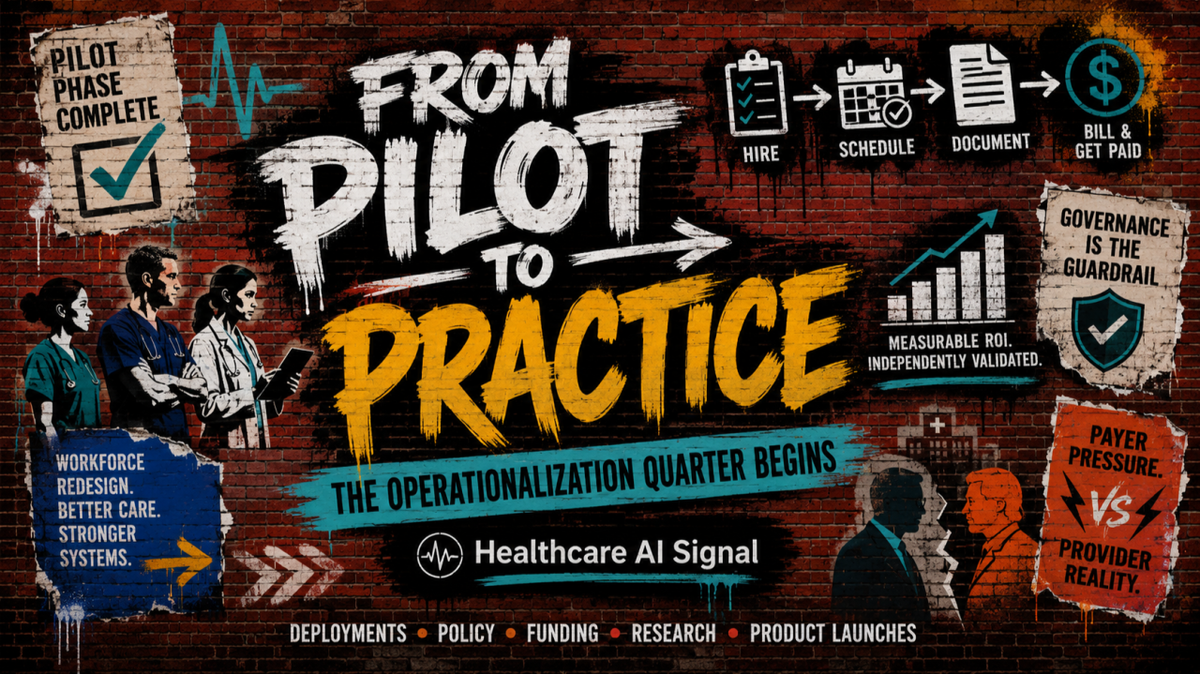
For operators, this week's signal is unambiguous. Ambient AI is no longer the question, workforce redesign around AI, clinical and back-office, is. Four deployment data points landed at named systems with documented achieved metrics, and they describe the new procurement reality.
Abridge made nursing AI generally available across 250+ health systems including Mayo Clinic, Johns Hopkins, Emory, and Corewell, with reported 30-minute-per-shift savings, the first time ambient AI has expanded as a clinical category beyond physicians at scale. Providence documented 90% reduction in manager hiring time on IBM watsonx Orchestrate, the first named-system enterprise agentic AI deployment in healthcare HR with hard metrics. First Rehabilitation cut documentation time from 40 minutes to 5 minutes per visit using Spry's AI scribe paired with billing automation, lifting revenue 37%. KLAS Research published independent multi-site ROI validation of Suki across FMOL Health, McLeod Health, and Rush University Medical Center, the first procurement reference benchmark the category has had.
The pattern across all four is the same. The technology works. The procurement decision is solvable. What separates the systems that win the next 24 months from the systems that absorb efficiency gains without measurable outcomes is operating-model redesign. Recovered clinician time has to be deliberately reallocated, into patient time, into reduced overtime, into different acuity ratios, into scope-of-practice changes, or it disappears into existing workloads and nothing shows up on the workforce metrics. The early physician scribe wave is the documented failure mode: high satisfaction, no measurable financial or workforce outcome.
The systems making different operational decisions this quarter will look different in two years. The leading indicators are not new AI deployments. They're staffing model changes, unit redesigns, scope-of-practice adjustments, and labor negotiations that follow AI deployments. Operators whose AI conversation lives inside IT and the CMIO's office are six months behind operators whose CNO, CHRO, COO, and CMIO are coordinating in the same room. Procurement is the cheap part. Operational redesign is the part with durable financial impact.
The next question for operators is no longer "should we deploy ambient AI?" It is "what is the operating model that captures the value, and is our governance posture mature enough to defend it under the new ACR-style profession-led scrutiny that's now landing across specialties?"
1. Signal Summary
- Abridge made nursing AI generally available at 250+ health systems. This might be the operational moment ambient AI became a clinical workforce strategy, not a physician tool. Reported 30-minute-per-shift savings.
- Providence documented 90% reduction in manager hiring time on IBM watsonx Orchestrate first named-system enterprise agentic AI deployment in healthcare HR with hard metrics.
- First Rehabilitation lifted revenue 37% with Spry's AI scribe + billing automation; documentation time fell from 40 minutes to 5 minutes per visit.
- KLAS independently validated Suki ambient AI ROI across FMOL, McLeod, and Rush creating the first procurement reference benchmark the category has had.
- The American College of Radiology approved its first Imaging AI Practice Parameter alongside Assess-AI, giving operators a governance template other specialties will copy within 12 months.
- A Medical Economics analysis surfaced payer-provider "bot wars" in prior authorization — the operational risk most operators have not yet planned for.
2. Big Signal of the Week
Abridge Expands Nursing AI Platform to 250+ Health Systems
🔴 Real-World Deployment | Score: 8.5 (High Signal) | View Article
Why It Matters Physician-focused ambient AI has saved minutes per encounter. Nursing documentation is hour-by-hour and shift-long. The operational impact compounds differently. A 30-minute-per-shift recovery across a 5,000-nurse system implies workforce planning decisions most CNO teams have never had to make, what does the recovered time fund, more patient time, fewer overtime hours, higher acuity ratios, different unit staffing?
Key Details
- Vendor: Abridge
- Named systems: Mayo Clinic, Johns Hopkins Medicine, Emory Healthcare, Corewell Health, Bon Secours Mercy Health, Reid Health
- Achievement: General availability at 250+ health systems (May 6, 2026)
- Reported outcome: Up to 30 minutes saved per shift
- Integration: Native Epic
- Co-development: Nursing-led product design
What This Signals Nursing documentation is now a defined AI category. The first three operators to publish a workforce redesign tied to nursing AI will set the industry pattern.
My Read Operators who deploy the tool but leave staffing models untouched will see efficiency gains absorbed without measurable workforce benefit, the documented failure mode from the early physician scribe wave. Procurement is the cheap part. Labor partnership and operating-model redesign are the hard parts. Watch for retention data at named sites within two quarters; whether nursing unions enter the recovered-time conversation; and whether competitors (Suki, Microsoft Nuance, Nabla) ship nursing products inside 60 days, current absence of competition is itself a signal.
Source: Newsweek
3. Real World Deployments
Providence Documents 90% Manager Hiring Time Reduction With IBM watsonx Orchestrate
🔴 Real-World Deployment | Score: 8.0 | View Article
Why It Matters First named-system enterprise agentic AI deployment in healthcare HR with documented hard metrics. Providence is running IBM's watsonx Orchestrate agent in production for caregiver hiring, reporting 90% reduction in manager time and 70% efficiency improvement. Back-office agentic AI has graduated from demo to documented operational outcome.
Key Details
- Provider: Providence
- Vendor: IBM Consulting / watsonx Orchestrate (with AWS, SAP)
- Use case: AI-powered HR agent for caregiver hiring
- Achieved metrics: 90% reduction in manager time, 70% process efficiency
- Stage: Production deployment
- Announced: IBM Think 2026 (May 6)
What This Signals Operators evaluating agentic AI in back-office workflows can now reference a named-system hard-metric deployment. The category is moving past pilot.
My Read The 90% manager-time figure will be quoted in every back-office AI sales conversation for the next 12 months. The operator question is whether the agent architecture scales into clinical workflows where exception-handling is the norm. For now, COOs and CHROs should define a parallel back-office agent strategy alongside clinical AI, not after. Operators waiting for clinical AI to mature before tackling back-office will lose the easier early wins to competitors moving in parallel.
Source: PR Newswire (IBM press release)
First Rehabilitation Boosts Revenue 37% With AI Scribe + Billing Automation
🔴 Real-World Deployment | Score: 8.0 | View Article
Why It Matters The cleanest ambulatory AI ROI case study of the week. Documentation time fell from 30–40 minutes per visit to ~5 minutes; revenue rose 37% via higher visit volume and lower cancellations. A CFO-grade proof point that pairs operational and revenue-cycle impact in one deployment.
Key Details
- Provider: First Rehabilitation (outpatient rehab)
- Platform: Spry (AI scribe + integrated billing)
- Documentation time: 30–40 min → ~5 min per visit
- Revenue impact: 37% increase
- Operational gains: Higher visit volume, fewer cancellations, accelerated billing
- Use case: Specialty ambulatory clinical and revenue-cycle automation
What This Signals Ambulatory operators piloting scribes without revenue-cycle integration are leaving the majority of the value uncaptured. The workflow redesign, not the scribe alone, is where the ROI lives.
My Read The 8x documentation reduction (40 min → 5 min) is the metric that pays for the integration. Any ambulatory operator running a scribe-only deployment now has a peer benchmark explaining why their revenue line hasn't moved. Specialty groups should re-evaluate whether the scribe is the front end of a wider workflow play or a point solution that has hit its ROI ceiling.
Source: Healthcare IT News (HIMSS Media)
KLAS Independently Validates Suki Ambient AI ROI Across FMOL, McLeod, and Rush
🔴 Real-World Deployment | Score: 8.0 | View Article
Why It Matters First independent multi-site ROI validation in the ambient AI category. KLAS Research documented reductions in documentation time, after-hours work, and physician burnout across three named systems, plus financial benefit from coding uplift and patient experience improvement.
Key Details
- Vendor: Suki
- Validator: KLAS Research
- Named systems: FMOL Health, McLeod Health, Rush University Medical Center
- Documented outcomes: Significant reductions in documentation time, after-hours work, physician burnout
- Financial impact: Coding-uplift revenue gains; improved patient experience scores
- Study type: Multi-system independent ROI validation
What This Signals Procurement teams now have a published reference benchmark for the ambient AI category. Vendors without comparable independent data face a credibility deficit they didn't have 30 days ago.
My Read The "four-minute mile" framing is doing real work, the implication is that the category has a published baseline, and every vendor below it has to explain why. Operators evaluating ambient AI without KLAS-comparable data are taking on more vendor risk than they need to. Expect competing vendors to commission their own KLAS engagements within 90 days.
Source: Becker's Hospital Review
4. Market Signals
Tempus AI–Quanterix Collaboration on Blood-Based Alzheimer's Diagnostics
🔴 Market Signal | Score: 7.5 | View Article
Why It Matters Tempus is now operating as a clinical distribution layer, not just a data company. Neurologists can order Quanterix's LucentAD blood-based Alzheimer's biomarker panel directly through Tempus's clinical ordering platform under a care-gap program.
Key Details
- Organizations: Tempus AI, Quanterix
- Product: LucentAD blood-based Alzheimer's biomarker panel
- Mechanism: Neurologist ordering via Tempus clinical ordering platform
- Program: Care-gap initiative for Alzheimer's screening
What This Signals AI platforms are becoming distribution surfaces, not just analytics surfaces. Diagnostic vendors without platform distribution will struggle to capture ordering volume.
My Read Tempus is positioning to be the "Amazon of AI diagnostics", a searchable, orderable catalog. The Quanterix integration is the proof point. For competing biomarker vendors, the question is whether they can defend a direct-to-clinician sales motion against a platform model.
Source: Quanterix Investor Press Release (Business Wire)
5. Policy and Regulation
ACR Approves First-Ever Imaging AI Practice Parameter, Launches Assess-AI Registry
🔴 Policy / Regulation | Score: 8.2 | View Article
Why It Matters First profession-led clinical AI governance scaffold. The ACR–SIIM Practice Parameter is paired with Assess-AI, a national quality registry monitoring real-world imaging AI performance. The template every other specialty will adapt.
Key Details
- Organizations: American College of Radiology (ACR), Society for Imaging Informatics in Medicine (SIIM)
- Action: First formal Practice Parameter for Imaging AI
- Companion: Assess-AI national quality registry
- Publication: JACR methodology article
- Function: Real-world performance monitoring, governance, benchmarking
What This Signals Vendors with quality-registry-ready data pipelines gain a structural advantage. Vendors without continuous monitoring face a competitive ceiling.
My Read The Assess-AI registry will be referenced by FDA and CMS within 12 months. Operators should align imaging AI evaluation against this parameter now. ASCO, ASH, and ACC will face pressure to publish comparable AI practice parameters in their specialties next, health systems that pre-position will avoid the retrofit cycle.
Source: Newswise (American College of Radiology)
Why AI May Be Making Your Administrative Burden Worse — The "Bot Wars"
🔴 Policy / Regulation | Score: 8.0 | View Article
Why It Matters Medical Economics documented payer-provider "bot wars" in prior authorization, downcoding responses from payers to AI-driven coding uplift, and growing inequity for smaller practices. The operational risk most operators have not yet planned for.
Key Details
- Publication: Medical Economics (May 8, 2026)
- Phenomena documented: "Bot wars" in prior auth, payer downcoding in response to AI scribes, smaller-practice exposure
- Named operators: Mass General Brigham, Optum Rx, Cleveland Clinic
- Solution piloted: Real-time prior auth adjudication (Optum Rx / Cleveland Clinic)
What This Signals Operators whose AI strategy assumes payers will sit still are planning against the wrong baseline.
My Read Real-time prior auth pilots are the only durable answer to the escalation. Operators whose AI ROI models don't factor in payer countermeasures are overstating the upside. The smaller-practice equity angle is the political risk, if AI economics consolidate against independent practices, expect state-level regulatory pressure within 18 months.
Source: Medical Economics
Pennsylvania Sues Character.AI Over Chatbot Posing as Licensed Psychiatrist
🔴 Policy / Regulation | Score: 8.0 | View Article
Why It Matters First state-AG enforcement action against generative AI for unlicensed practice of medicine. Pennsylvania alleges a Character.AI chatbot impersonated a licensed psychiatrist with a fabricated license number.
Key Details
- Plaintiff: Pennsylvania AG (Shapiro administration)
- Defendant: Character.AI
- Filed: May 5, 2026
- Allegation: Chatbot impersonated licensed psychiatrist, fabricated license number
- Legal frame: Unlicensed practice of medicine via generative AI
What This Signals Any consumer-facing AI tool with adjacent mental-health content needs licensed clinician oversight in the workflow, not a disclaimer.
My Read The fabricated-license-number detail is the replicable fact pattern. Expect comparable filings in 3–5 states within 12 months. AI governance committees should add an unlicensed-practice review to every patient-facing AI evaluation.
Source: Fierce Healthcare
6. Funding Signals
Roche Signs Definitive Agreement to Acquire PathAI
🔴 Funding Signal | Score: 8.2 | View Article
Why It Matters Largest pharma-led AI infrastructure acquisition of the year. Pathology is the upstream choke point of precision oncology, whoever owns the AI layer controls companion diagnostics for the next decade.
Key Details
- Acquirer: Roche
- Target: PathAI
- Date: May 7, 2026 (definitive merger agreement)
- Strategic rationale: Integrate AI pathology with Roche Diagnostics for companion diagnostics scale
What This Signals Standalone AI pathology vendors face a narrowing exit window. Expect a second top-10 pharma to announce a comparable acquisition within two quarters.
My Read The consolidation pattern is the signal, not the single deal. Health system pathology departments should expect vendor consolidation to compress procurement options within 18 months.
Source: BioSpace (Roche press release)
Modicus Prime Raises $8M for AI Audit Readiness in Pharma
🔴 Funding Signal | Score: 7.2 | View Article
Why It Matters First well-funded AI compliance tooling vendor focused on GxP environments. AI audit readiness is becoming a regulatory requirement.
Key Details
- Company: Modicus Prime
- Raise: $8M
- Investors: Frist Cressey Ventures, Silverton Partners, Oncology Ventures
- Product: Trustworthy AI Compliance Software
- Target: Pharma GxP workflows
What This Signals AI compliance tooling is becoming its own venture vertical. Comparable clinical AI compliance vendors should emerge within 12–18 months.
My Read The Frist Cressey lead is the institutional signal. Health system AI governance teams should expect a comparable clinical AI audit-readiness vendor by year-end. Build the documentation now; retrofitting under audit pressure is more expensive.
Source: PR Newswire
7. Research Breakthroughs
AI-ECG Validates Heart Failure Screening in Resource-Limited Settings (UT Southwestern / Kenya)
🔴 Research Breakthrough | Score: 8.2 | View Article
Why It Matters Specialist-level cardiology screening without a specialist, in a low-resource setting. The model that works in Kenya works in rural Tennessee.
Key Details
- Institution: UT Southwestern Medical Center
- Partners: AstraZeneca, Tricog Health
- Site: Kenya
- Target: Left ventricular systolic dysfunction (LVSD)
- Technology: AI-enhanced ECG on low-cost handheld devices
- Companion publication: JAMA Cardiology
What This Signals Validates a global commercial model where pharma co-funds diagnostic AI for population-scale case finding that expands therapeutic addressable populations.
My Read The AstraZeneca partnership is the structural detail. Watch for additional pharma-diagnostic AI partnerships in cardiology, diabetes, and respiratory care over the next 12 months, particularly in rural U.S. markets with comparable specialist shortages.
Source: UT Southwestern Medical Center
RESPECT: First Peer-Reviewed RAG AI for Clinical Trial Consent (npj Digital Medicine)
🔴 Research Breakthrough | Score: 8.2 | View Article
Why It Matters First peer-reviewed evaluation of a RAG LLM consent assistant with novel safety metrics. The Refusal–Utility Curve framework establishes the first quantified safety-utility tradeoff measure for patient-facing GenAI in regulated research.
Key Details
- Publication: npj Digital Medicine (Nature), May 9, 2026
- System: RESPECT (RAG-based LLM consent assistant)
- Novel metric: Refusal–Utility Curve (RUC)
- Comparison: Higher appropriate-refusal vs. GPT-4
What This Signals Quantified safety-utility tradeoffs are now publishable in top journals; expect them in IRB protocols within 18 months.
My Read The RUC framework is portable across patient-facing GenAI categories. Research operations leaders should expect IRBs to start asking for refusal-utility data on any generative AI in trial workflows.
Source: npj Digital Medicine (Nature)
8. Trend to Watch: Workforce Redesign Is the Next Procurement Question
The week's deployment signals, Abridge nursing, Providence's 90% manager-time reduction, First Rehabilitation's 37% revenue lift, KLAS-validated Suki, point at the same operator question: once AI saves time, what changes about the work? Most health systems have answered that implicitly by reabsorbing recovered minutes into existing workloads. That's why the early scribe wave produced clinician satisfaction without measurable workforce outcomes.
The systems making different operational decisions this quarter will look different in two years. The leading indicators are not new AI deployments. They're staffing model changes, unit redesigns, scope-of-practice adjustments, and labor negotiations that follow AI deployments. Operators with their CHRO and CNO in the AI conversation today are six months ahead of operators whose AI conversation lives only with IT and the CMIO.
9. Signal Scoreboard — Top 10 New Stories
RankHeadlineScoreCategoryWhy It Matters
1 Abridge Nursing AI to 250+ Systems | 8.5 | DeploymentFirst ambient AI category expansion to nurses at scale.
2 ACR Imaging AI Practice Parameter | 8.2 | PolicyFirst profession-led clinical AI governance scaffold.
3 AI-ECG Heart Failure Screening (Kenya) | 8.2 | ResearchSpecialist-level screening without a specialist.
4 RESPECT RAG AI for Clinical Trial Consent | 8.2 | ResearchFirst peer-reviewed Refusal–Utility safety framework.
5 Roche Acquires PathAI | 8.2 | FundingPharma claims AI pathology as core infrastructure.
6 Providence 90% Manager Time Reduction (IBM watsonx) | 8.0 | DeploymentFirst named-system agentic AI HR with hard metrics.
7 First Rehabilitation 37% Revenue Lift | 8.0 | Deployment40 min → 5 min documentation collapse.
8 KLAS Validates Suki Ambient AI ROI | 8.0 | DeploymentFirst independent procurement reference.
9 Medical Economics: Prior-Auth Bot Wars | 8.0 | Policy/OpPayer countermeasures as operational risk.
10. Noise of the Week
How Ambient AI Can Transform Team-Based Care
🟡 Real-World Deployment | Score: 4.0 | View Article
Why It Looks Important Ambient AI is the dominant deployment story this week. Commentary on team-based care implications.
Why It Is Actually Noise No named deploying organization, no live implementation, no measurable outcome. Commentary, not signal.
Source: MedPage Today
Snowflake: Data Foundation Fuels AI in Healthcare
🟡 Real-World Deployment | Score: 4.0 | View Article
Why It Looks Important Data infrastructure is a real constraint for clinical AI.
Why It Is Actually Noise Vendor marketing dressed as analysis. No named customers, no quantified outcomes.
Source: StartupHub.ai