
Cleared and Proven, but Not Yet Paid
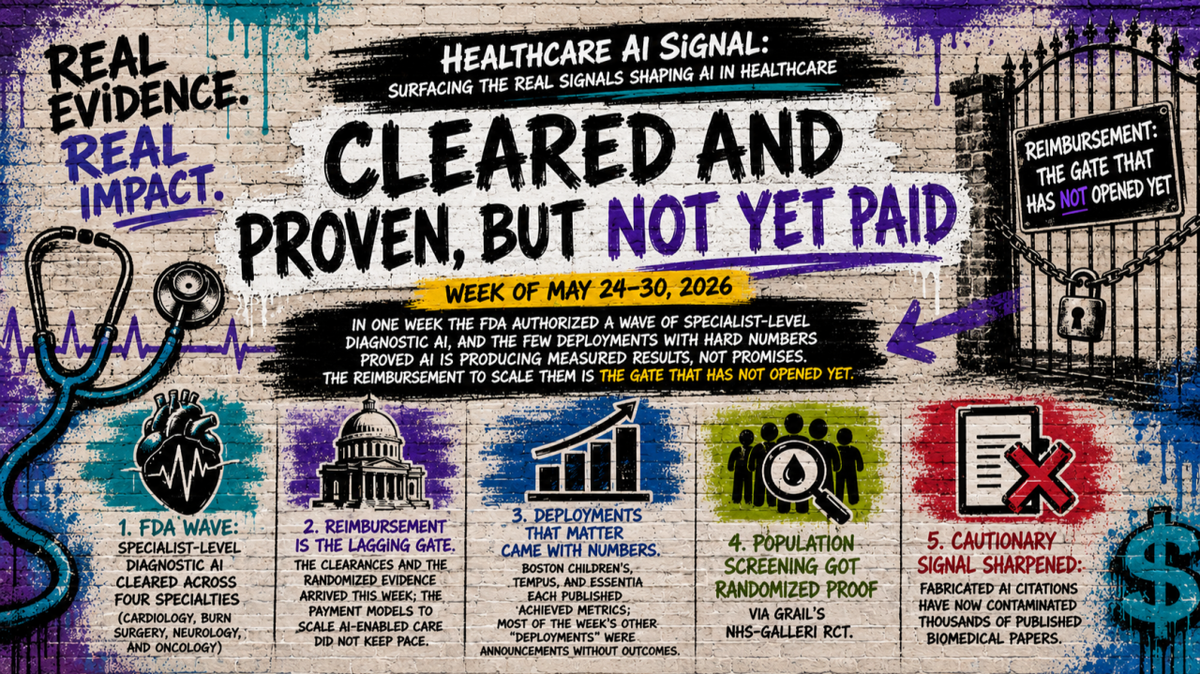
Healthcare AI Signal: Surfacing the real signals shaping AI in healthcare
Week of May 24–30, 2026
This week, two of the three gates that move AI from promise to scale swung open, and the third stayed shut. The FDA cleared a wave of specialist-level diagnostic AI (noninvasive heart-failure monitoring, burn assessment, intracranial-EEG review, and an expanded oncology companion diagnostic), signaling that narrow, well-bounded indications are now the reliable path to market. At the same time, a handful of deployments proved their value with documented numbers at named operators: Boston Children's (40 rare-disease diagnoses, roughly $7M saved), Tempus (measurable guideline-adherence gains across six community systems), and Essentia (560 clinician hours saved). What did not arrive was reimbursement. No payment model emerged to fund AI-enabled care at scale, leaving even strong evidence running ahead of the dollars.
The week's caution sits underneath all of it: fabricated AI citations have now reached thousands of biomedical papers, a reminder that verification has to scale alongside adoption. For leaders, the move is to deploy where ROI is self-funding today, treat any deployment without published outcomes as still in pilot, and track which clearances convert into paid, covered use.
1. Signal Summary
- The FDA cleared specialist-level diagnostic AI across four specialties (cardiology, burn surgery, neurology, and oncology) in a single week.
- Reimbursement is the lagging gate. The clearances and the randomized evidence arrived this week; the payment models to scale AI-enabled care did not keep pace.
- The deployments that matter came with numbers. Boston Children's, Tempus, and Essentia each published achieved metrics; most of the week's other "deployments" were announcements without outcomes.
- Population screening got randomized proof via GRAIL's NHS-Galleri RCT.
- The cautionary signal sharpened: fabricated AI citations have now contaminated thousands of published biomedical papers.
2. Big Signal of the Week
FDA De Novo for AI PCWP Estimation Validates a Noninvasive Pathway for Heart-Failure Wearables
🟡 Major Signal | Score: 7.8 | View Article
Why It Matters This is the cleanest example of the week's dominant pattern: the FDA granting market access to AI that performs a specialist-level measurement without the specialist or the invasive procedure. Cardiosense's software estimates pulmonary capillary wedge pressure (a number that has historically required cardiac catheterization) noninvasively. A De Novo classification creates a brand-new regulatory category, which means it becomes the template the next wearable cardiac-AI submission is measured against.
Key Details
- Organization: Cardiosense
- Action: FDA De Novo classification for PCWP Analysis Software
- Capability: AI-based noninvasive estimation of pulmonary capillary wedge pressure, paired with the CardioTag wearable sensor
- Indication: Adult HFrEF (heart failure with reduced ejection fraction) patients
- Clinical value: Enables earlier heart-failure intervention without invasive catheterization
What This Signals Regulators are creating viable approval routes for AI tools that substitute for invasive diagnostics, accelerating remote monitoring beyond the pilot stage. Heart-failure and cardiology programs should reassess catheterization and remote-monitoring protocols for potential substitution by a cleared device.
My Read The De Novo detail is the whole story. A 510(k) rides on a predicate; a De Novo means there was no predicate: the FDA built the category. That is the agency signaling it will authorize AI that removes a specialist bottleneck, not just one that assists. Pair this with the burn, EEG, and companion-diagnostic clearances in the same week and the pattern is unmistakable: narrow, well-bounded, specialist-replacing indications are the path of least regulatory resistance right now. Heart-failure programs still sending every patient to the cath lab for a wedge pressure now have a cleared alternative working against their own cost and access metrics.
Source: Medical Economics
3. Real World Deployments (documented achieved metrics only)
Boston Children's Reports 40 Rare-Disease Diagnoses and $7M Savings From Enterprise AI Copilots
🔴 Real-World Deployment | Score: 8.1 | View Article
Why It Matters This is the rare deployment story with documented results across both clinical yield and operations at a named flagship operator. Boston Children's built an enterprise AI layer (a HIPAA-aligned internal ChatGPT environment plus a custom "co-pilot geneticist") and published what it produced, not what it hopes to produce.
Key Details
- Organization: Boston Children's Hospital (with OpenAI)
- Build: Internal ChatGPT environment + "co-pilot geneticist" for variant interpretation
- Achieved: 40+ previously unresolved rare-disease diagnoses
- Achieved: ~60,000 hours saved across automations
- Achieved: ~$7M in redeployed labor savings
- Scope: Clinical, research, and administrative workflows
What This Signals The internal-platform-plus-specialist-copilot pattern is now a modelable ROI case. The diagnostic-yield figure matters most: AI surfacing answers in cases that had stalled is a different value proposition than time savings alone.
My Read Strip the vendor logo off and the lesson is the architecture: a governed internal environment plus narrow, high-value copilots aimed at specific workflows (genetics, administration), with the outcomes measured. Most enterprise-AI announcements report deployment; this one reports results.
Source: OpenAI (Customer Stories)
Tempus AI Demonstrates Measurable Oncology Biomarker Gains Across Six Community Health Systems
🟡 Real-World Deployment | Score: 7.3 | View Article
Why It Matters Community oncology is where guideline adherence usually slips, and Tempus published a multi-center prospective study showing AI decision support moved it measurably, not in an academic showcase, but across diverse community systems.
Key Details
- Organization: Tempus AI; six U.S. community health systems
- Product: Next real-time clinical intelligence platform (expansion announced May 28), six new oncology scenarios
- Achieved: +24% ALK guideline biomarker testing
- Achieved: +18% EGFR guideline biomarker testing
- Achieved: Higher guideline-concordant therapy rates
- Design: Multi-center prospective study
What This Signals Real-world AI-CDSS deployments are beginning to show repeatable, documented operational impact on guideline adherence in community settings, the hardest place to move the number.
My Read The community-systems detail is the signal most coverage will skip. An adherence lift at an academic flagship is expected; a documented lift across six community systems is evidence the tool works where the staffing and informatics support are thinnest. Health systems should evaluate decision support that embeds directly into existing biomarker-ordering and therapy-selection workflows, and ask for the prospective data, not the retrospective demo.
Source: Tempus AI (Investor News / Business Wire)
Essentia Deploys Documentation AI to 3,000 Rural Workers With 560 Clinician Hours Saved
🟡 Real-World Deployment | Score: 7.1 | View Article
Why It Matters Administrative-burden AI is reaching operational scale even in rural settings where capital and staffing are most constrained, and Essentia reported the hours saved rather than projecting them.
Key Details
- Organization: Essentia Health (with Epic)
- Deployment: EHR-embedded documentation AI that drafts patient-message responses and prepares clinicians for visits
- Achieved: 560 clinician hours saved on drafted correspondence
- Scale: 3,000+ active staff users across rural sites
What This Signals AI for administrative-burden reduction is delivering measured ROI even where resources are tight, and the win comes from embedded, in-workflow tools rather than standalone platforms.
My Read The 3,000-user breadth is what makes the 560-hour figure credible: this isn't a power-user pilot, it's broad adoption with a measured output. For rural and community systems waiting for "more advanced" capabilities, Essentia is the peer benchmark showing the value is available now, in the EHR, from the unglamorous use cases.
Source: Healthcare IT News
4. Market Signals
FDA De Novo Clearance Opens a Commercial Path for AI Multispectral Burn Assessment
🟡 Major Product Launch | Score: 7.4 | View Article
Why It Matters Spectral AI's DeepView won De Novo classification for rapid, noninvasive burn-wound healing assessment, authorized for U.S. commercial distribution. Clearance is the difference between an interesting model and a product a burn center can buy.
Key Details
- Organization: Spectral AI (with BARDA)
- Action: FDA De Novo classification (press release May 26, 2026)
- Technology: Multispectral imaging + AI for burn-wound healing-potential assessment
- Authorized settings: Burn centers, trauma centers, emergency departments
- Status: Cleared for U.S. commercial distribution
What This Signals Regulatory validation is becoming a reliable on-ramp for AI diagnostic tools, shifting the competitive focus from model performance to post-clearance adoption and evidence generation.
My Read Two De Novo clearances for narrow imaging/measurement AI in one week (Spectral and Cardiosense) is not a coincidence: it's the FDA telling vendors which door is open. The moat here is the clearance, not the algorithm; competitors without one are now selling against a cleared device. Burn and trauma programs should evaluate procurement and workflow integration now, and watch first installations for real-world time-to-decision data.
Source: D Magazine
FDA Clearance Validates AI for Flagging Key Segments in Long-Term Intracranial EEG
🟡 Regulation / Market Access | Score: 7.0 | View Article
Why It Matters NeuroPace's ECoG Assistant won FDA clearance to flag "ECoGs of Interest" in long-term intracranial EEG data from the RNS System, opening market access for an AI tool that reduces clinician review burden in a high-density specialty data stream.
Key Details
- Organization: NeuroPace
- Action: FDA clearance of ECoG Assistant (reported May 30, 2026)
- Capability: Flags segments of interest in long-term intracranial EEG (iEEG) and consolidates trend visualizations
- Workflow: Streamlines clinician review of RNS System data
- Pipeline: Next-generation Patient Data Management System submitted for review to enable broader AI workflows
What This Signals Regulators are opening market access for AI tools that reduce review burden in specialized, high-density physiologic data rather than broad diagnostics, a narrower but reliable clearance pattern.
My Read This is the same week's clearance logic applied to neurology: a narrow, well-bounded, review-burden indication is exactly the profile the FDA is authorizing right now. The market read is that specialty AI with a defined clinical setting clears faster than broad diagnostic ambition, so the competitive race is to find the next well-bounded indication. RNS users should prepare review workflows for AI-assisted triage once the feature ships.
Source: TechInsyte
5. Policy and Regulation
FDA Deploys Internal Generative AI to Consolidate Regulatory Systems and Review Workflows
🟡 Regulation and Policy | Score: 7.6 | View Article
Why It Matters The agency that clears AI products now runs on AI internally. The FDA's Elsa 4.0 and HALO consolidate 40+ internal submission systems with generative AI as the interface for querying and synthesizing regulatory data.
Key Details
- Organization: U.S. Food and Drug Administration
- Tools: Elsa 4.0 (internal generative-AI decision support); HALO (Harmonized AI & Lifecycle Operations for Data)
- Action: Consolidation of 40+ internal submission systems (announced May 6; JMIR coverage May 29)
- Function: AI interface for querying and synthesizing regulatory data
- Noted risks: Error propagation, deskilling, verification burden
What This Signals Regulators are moving AI from an external oversight topic to core operational infrastructure, creating new expectations around submission data quality and verification.
My Read This cuts both ways for sponsors. AI-augmented reviews could compress timelines, but they also mean your submission data structure now has to align with how the agency's AI ingests and synthesizes it. The risk list the FDA itself flagged (error propagation, deskilling) is the tell: even the regulator is learning that adoption and verification have to scale together. Align submission data to HALO standards and watch for guidance on AI-assisted review.
Source: Journal of Medical Internet Research (JMIR)
6. Funding Signals
Oncology AI Series B Signals Buyer Demand for Workflow Automation in Cancer Centers
🟡 Funding Signal | Score: 7.4 | View Article
Why It Matters Triomics raised $22M to scale oncology-specific AI at named cancer centers, capital following a proven, vertical operational use case rather than a generalist tool.
Key Details
- Organization: Triomics; lead investor Battery Ventures
- Raise: $22M Series B
- Product: Oncology-focused AI for trial matching, verifiable patient summaries, and registry submission
- Named users: Memorial Sloan Kettering, Yale Cancer Center
- Positioning: Domain-specific alternative to generalist medical-scribe tools
What This Signals Healthcare AI is advancing from general copilots toward vertical, workflow-owned tools that address high-value operational bottlenecks in specialized care.
My Read The investor thesis here is that depth beats breadth: an oncology-native tool defends against horizontal platform players precisely because it owns the trial-matching and registry workflows generalists can't. For cancer centers, the actionable question is whether oncology-specific automation outperforms the general-purpose scribe you already license. Watch for live multi-site adoption data and quantified efficiency gains at the named centers.
Source: TechCrunch
AI Agents Show Traction in Revenue Cycle With Named Health-System Scale
🟡 Funding Signal | Score: 7.2 | View Article
Why It Matters Commure raised $70M at a $7B valuation to scale agents it says complete the majority of revenue-cycle work autonomously. The capital is flowing toward agents that act, not copilots that assist.
Key Details
- Organization: Commure; investors include General Catalyst, Sequoia Capital
- Raise: $70M at a $7B valuation
- Claim: AI agents complete 85%+ of revenue-cycle work without human intervention
- Reach: 500+ healthcare organizations, including HCA and Tenet
- Target: Healthcare's ~$1T administrative burden
What This Signals Capital is flowing toward autonomous agents that can own entire high-volume administrative workflows, a step beyond the copilot model that dominated 2025.
My Read The 85% figure is a claim, not a documented outcome, and that distinction matters this week of all weeks. The funding signals real buyer demand, but health systems should treat the autonomy number as a hypothesis to validate against denial rates, days-in-A/R, and FTE impact at named customers. The vendors that publish those metrics will separate from the ones that publish valuations.
Source: The AI Insider
Safety-Net Hospitals Limit AI to Embedded EHR Tools Amid Severe Capital Constraints
🟢 Funding Signal | Score: 6.1 | View Article
Why It Matters While capital concentrates at the top of the market, a Disproportionate Share Hospital system describes the other end: tight margins that confine AI to low-risk, embedded options only. The buyer market is bifurcating as fast as the vendor market.
Key Details
- Organization: USA Health (three-hospital DSH system)
- Constraint: Tight margins limiting capital for AI investment
- Strategy: Prioritizing embedded EHR augmentations and ROI-focused, lower-risk vendor choices
- Pain point: Mid-cycle revenue-cycle challenges where AI could help but funding is constrained
What This Signals AI adoption will remain uneven, with under-resourced providers defaulting to incremental EHR augmentations rather than new platforms, a widening gap with well-capitalized systems.
My Read This is the counterweight to every $70M raise this week. The premium-AI addressable market is narrower than the headlines suggest, because a large share of providers can only buy what's already embedded in the EHR with immediate ROI. Vendors targeting safety-net and rural buyers must lead with embedded, quick-payback tools; Essentia's documentation win is the template, not a frontier platform.
Source: Healthcare Finance News (HIMSS Media)
7. Research Breakthroughs
NHS RCT Shows MCED Test Shifts Cancer Diagnoses to Earlier Stages
🟡 Research Breakthrough | Score: 7.8 | View Article
Why It Matters GRAIL released full NHS-Galleri randomized controlled trial results showing its multi-cancer early detection blood test reduced late-stage diagnoses when added to standard screening. This is the population-scale randomized evidence the entire MCED market has been waiting on.
Key Details
- Organizations: GRAIL, NHS England
- Test: Galleri multi-cancer early detection (MCED) blood test
- Achieved: 22% reduction in Stage IV diagnoses (round 2); 26% reduction (round 3) for a pre-specified 12-cancer group
- Achieved: Increased early-stage (I–II) detection when added to standard screening
- Venue: Full results presented at the 2026 ASCO Annual Meeting (May 30)
What This Signals Real-world evidence for multi-cancer early detection is accumulating faster than adoption pathways or reimbursement frameworks; MCED claims are now increasingly evidence-based rather than speculative.
My Read The market story is the trial design, not the percentages. A randomized trial at NHS scale is a capital-and-credibility flex smaller competitors can't match, and it does for screening what a De Novo does for devices: it converts evidence into market access rivals have to answer. Watch reimbursement closely: the evidence is now ahead of the payment model, and whoever closes that gap first captures the market.
Source: PR Newswire (GRAIL)
Widespread AI-Generated Fake Citations Expose Validation Gaps in Biomedical Research
🟡 Controversy / Research | Score: 7.2 | View Article
Why It Matters A correspondence to The Lancet quantified how AI hallucinations are corrupting the scientific record at scale, the same evidence base clinical decisions and AI training rely on.
Key Details
- Source of finding: Correspondence published in The Lancet
- Scale: 4,046 fabricated references across 2,810 published articles over three years
- Rate: By 2026, roughly 1 in 277 papers carried presumed AI-fabricated citations
- Mechanism: Presumed AI hallucinations entering peer-reviewed literature
What This Signals Healthcare AI will face stricter requirements for output verification, provenance tracking, and human oversight as research-integrity problems become measurable and public.
My Read This is the necessary counter-signal to a week full of clearances and proof points. The same technology being authorized to act on clinical evidence is the one polluting it. Any organization using AI for literature review, evidence synthesis, or manuscript drafting needs a mandatory citation-verification step, and AI procurement should now ask vendors how they prevent fabricated provenance. Validation and verification have to scale together, or the proof era produces its own failure mode.
Source: Forbes
8. Trend to Watch
The week's signals describe two of the three gates AI has to pass through swinging open at once. The FDA cleared specialist-level diagnostics (Cardiosense, Spectral, plus an expanded Tempus companion-diagnostic label and an intracranial-EEG clearance). And the deployments worth featuring (Boston Children's, Tempus, Essentia) all came with documented numbers rather than promises. The third gate, reimbursement, stayed shut: no payment model arrived this week to help scale any of it.
That last point is the editorial signal. Strip out the announcement-stage rollouts and only a handful of deployments this week can show achieved results at a named operator. The gap between "deployed" and "proven" is where procurement risk still lives. The systems separating from the pack are the ones publishing metrics; the ones issuing partnership press releases are still in the pilot conversation, whatever the headline says.
The counter-signal keeps pace: the flood of fabricated AI citations is a reminder that the same technology being cleared to act is the one corrupting the evidence base. Cleared and proven are arriving; paid and verified are the parts still lagging, and they are what turn a strong week into a scalable one.
9. Signal Scoreboard: Top 10
Ranked by Signal Strength Score. Week of May 24, 2026. Deployments metric-verified.
- 8.1 | Deployment Boston Children's: 40 rare-disease diagnoses, $7M saved. Quantified clinical and financial yield from enterprise AI at a named operator.
- 7.8 | Policy Cardiosense FDA De Novo for noninvasive PCWP. Cleared AI substitute for an invasive cardiac diagnostic.
- 7.8 | Research NHS-Galleri RCT shifts cancers earlier. Randomized evidence for multi-cancer early detection at scale.
- 7.6 | Policy FDA deploys internal generative AI (Elsa/HALO). The regulator adopts AI as core review infrastructure.
- 7.4 | Market Spectral AI burn De Novo clearance. Clearance as the commercial on-ramp for diagnostic AI.
- 7.4 | Funding Triomics $22M Series B for oncology AI. Capital favors vertical, workflow-owned tools.
- 7.3 | Deployment Tempus oncology biomarker gains across six systems. Measured guideline-adherence lift in community oncology.
- 7.2 | Research AI-fabricated citations in biomedical papers. The evidence base itself is being contaminated.
- 7.2 | Funding Commure $70M at $7B for revenue-cycle agents. Capital shifts from copilots to autonomous administrative agents.
- 7.1 | Deployment Essentia documentation AI: 560 clinician hours saved. Measured ROI under capital constraint.
10. Noise of the Week
Legacy Payer Platforms Expose APIs for Agent-Driven Prior Authorization
🟢 Major Product Launch | Score: 4.8 | View Article
Why It Looks Important: Cognizant making TriZetto Unify "agent-ready" sounds like the infrastructure shift everyone's waiting for in prior authorization. Why It's Actually Noise: No named customers, no live deployments, and no cycle-time data, a vendor announcement only. API readiness is a capability, not adoption.
Source: Nasdaq (PR Newswire)
Voluntary CHAI Playbooks Offer AI Governance Templates but Carry No Enforcement Power
🟢 Regulation and Policy | Score: 4.3 | View Article
Why It Looks Important: Governance is the topic of the year, and the playbooks cover eight structured domains tied to voluntary Joint Commission certification. Why It's Actually Noise: Non-binding, trade-media-distributed templates with no mandate, no incentive, and no measured adoption; optional reference material, not a compliance event.
Source: Medical Buyer
Healthcare AI Signal is a high-signal briefing on the developments actually shaping AI in healthcare. Its lens is honest, urgent, and grounded in what is really happening, not just what official narratives choose to highlight.